
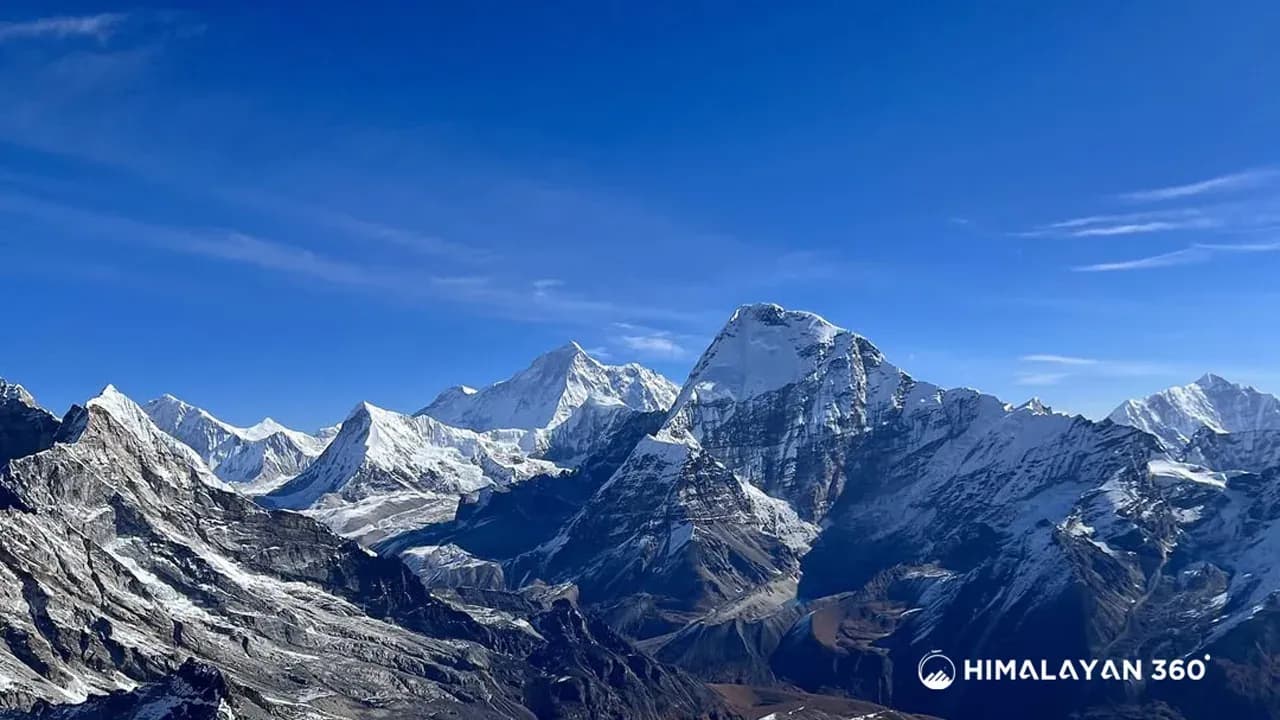
Mera Peak (6,476 m / 21,247 ft) is a climb, not a trek, and the ten things that decide whether you summit are all fixed before you leave Kathmandu. It is one of Nepal's most popular trekking peaks and it does not demand advanced technical skills, but it does demand basic mountaineering competence, real endurance, and an itinerary that gives your body time at altitude. From the top you look across Everest, Lhotse, Makalu and Cho Oyu.
The route runs through the Khumbu region, past Sherpa villages, rhododendron forests and high alpine ground, to a base camp at around 5,300 m and a high camp above it. Below is the short version of what to sort out first, followed by the detail on each point.
The 10 vital tips, in order of what will actually stop you:
- Treat it as a climb. The summit push is a steep snow slope, and you will use crampons, an ice axe and fixed ropes.
- Train for 4 to 6 weeks minimum, with cardio, leg and core strength, and hikes carrying the pack you will actually use.
- Do not go solo. A licensed guide is the difference between a hard day and an emergency in a place where rescue is slow.
- Know which route you are on, because it decides which permits you need. The two routes take different national parks.
- Budget properly. A fully supported guided climb typically runs USD 2,500 to USD 5,000 per person.
- Book spring or autumn, roughly April to May or September to November. The off-seasons are not a saving.
- Build acclimatization days into the itinerary rather than hoping to feel fine. Altitude is the main risk on this mountain.
- Expect tents, not teahouses, high up. Lodges run out below base camp and high camp is basic shelter.
- Get the boots right. Insulated, rigid-soled mountaineering boots that take crampons, tested before you fly.
- Carry the paperwork. Passport, permits, photocopies and passport photos, in your daypack and on your phone.
Mera Peak Climbing Overview
Located in the Khumbu region of Nepal, Mera Peak stands as a daunting challenge, requiring both physical fitness and prior trekking experience. The climb typically begins with a flight from Kathmandu to Lukla, followed by a trek through picturesque villages like Namche Bazaar and Pangboche, allowing for essential acclimatization. Base Camp, situated at around 5,300 meters (17,388 feet), serves as the starting point for the ascent, with climbers establishing higher camps before the summit push.
As the summit day commences, it involves steep snow slopes and a final ridge to the top, offering panoramic views of the world’s highest peaks. After reaching the summit, climbers descend back to Base Camp and trek back to Lukla, completing the expedition. While it’s possible to climb independently, most opt for guided expeditions for safety and logistical support, provided by experienced local guides who assist with route finding, equipment rental, and high-altitude medical care. Overall, climbing Mera Peak is a challenging yet achievable goal, offering an unforgettable adventure in the Himalayan landscape.
The Mera Peak Climbing Route, Stage by Stage
Mera Peak sits in the Hinku Valley, east of the main Everest region trail, and that is the whole character of the trip. You fly into Lukla with everybody else and then walk the other way, into a valley with no Namche, no bakeries and no crowd. Our Mera Peak Climbing itinerary runs 17 days door to door from Kathmandu, and the stage list below is what those days actually contain.
Lukla and the Khumbu Region to the Hinku Valley
After the international flight into Tribhuvan International Airport and a night in one of the hotels in Kathmandu, the trip drives to Manthali and flies to Lukla. From there it is a short walk to Chutanga at 3,020 m, then the first real day: the crossing of Zatrwa La Pass at 4,610 m to Thuli Kharka at 4,300 m. That single pass is what separates the Everest trail from the Hinku, and it is a serious day for so early in a trip. Some groups avoid it in heavy snow by taking the longer low approach over Panggom La Pass instead, which costs days but acclimatizes better.
Beyond the pass the trail drops to Kote at 3,691 m in the floor of the Hinku Valley, then climbs again to Thangnak at 4,356 m with a rest day there. The few settlements along the way are Sherpa, with the Tibetan Buddhist chortens and mani walls that go with that, though most are seasonal herding places rather than year-round villages. The descent to Kote after crossing so high looks like wasted altitude and is not: it is textbook climb high, sleep low, and it is one of the reasons this route works.
Khare, Mera La and the Final Ascent
Khare at 5,045 m is where the trek becomes a climb. It holds the last lodges, and the day spent there is for a rope, harness, crampon and ice axe session with the climbing guides rather than for sightseeing. Anyone who has never done a mountaineering course gets one here, compressed into an afternoon.
Above Khare the route crosses Mera La Pass onto the glacier to reach Mera Peak Base Camp at 5,350 m, and the high camp above it is tents on snow. Summit night starts in the small hours: crampons on in the dark, a steady push to the summit up snow that never gets steeper than a long walk, then a short final cone. The climb to the summit of Mera Peak at 6,476 m is about cold and altitude rather than technique, and most people who fail to reach the summit turn round because of one or the other. Summiting here is an endurance problem in a down suit. Sherpa support and Nepalese local staff carry the loads that make the high camp possible, and a good Mera Peak team will have a trekking guide, a climbing guide and enough hands to get one sick client down while the rest go on.
From the top the panorama is the reason people come. Everest, the highest mountain in the world, stands with Lhotse, Makalu, Cho Oyu, Kangchenjunga, Baruntse and Ama Dablam around it, and having summited a 6000m peak you get all of them in one turn. The descent goes back to Khare the same day, and the walk out retraces the Hinku Valley to Lukla.
Mera Peak or Island Peak? Choosing Between the Trekking Peaks in Nepal
Mera Peak is the highest trekking peak in Nepal, which is the honest reason to pick it and also the reason to be careful. Compared with the other trekking peaks in Nepal it asks less of your hands and more of your lungs.
- Mera Peak (6,476 m): the highest of them, a snow plod with a short summit cone, in a quiet valley. Views of Mera itself are modest on the walk in; the reward is the summit panorama.
- Island Peak (6,189 m): lower, busier, and technically harder, with a headwall and fixed rope near the top. It sits on the Everest Base Camp trail, so it doubles as a Nepali classic.
- Lobuche East (6,119 m): lower still, mixed ground, often climbed as preparation for something bigger.
If your background is trekking on established routes such as Everest Base Camp or the Annapurna Circuit and you want a first 6,000 m summit, Mera Peak in Nepal is the sensible one. If you want to learn rope work on steeper ground, Island Peak teaches more. Plenty of climbers do both in one season and treat the pair as a full trekking and climbing apprenticeship in the Himalayas.
How Difficult Is Mera Peak Climbing?
Climbing Mera Peak presents a challenging yet achievable attempt for adventurers seeking to conquer Himalayan heights. Standing at 6,476 meters above sea level, the ascent demands a combination of physical fitness, altitude acclimatization, and basic mountaineering skills. While Mera Peak does not require advanced mountaineering skills, some sections may involve basic climbing techniques like using crampons, ice axes, and fixed ropes. The final summit push typically involves ascending a steep snow slope.
A trekker should have a good level of physical fitness and endurance. The trek to the base camp involves long days of hiking with significant elevation gain, and the summit day is demanding.
However, Mera Peak can pose risks for travelers, primarily due to the high altitude, unpredictable weather, and remote location. Altitude sickness is a significant concern, and climbers need to acclimatize properly to reduce the risk. Additionally, harsh weather conditions, including high winds and snowfall, can make climbing challenging and potentially dangerous. The remote setting means that rescue operations in case of emergencies may be difficult.
In essence, with careful planning, adequate preparation, and experienced guides, many travelers successfully navigate these risks and enjoy the adventure of climbing Mera Peak.
Physical Fitness Requirements for Mera Peak Climbing
To climb Mera Peak, a good level of physical fitness is essential. Here are some key aspects of physical fitness required for Mera Peak climbing:
- Altitude Fitness:
As Mera Peak reaches high altitudes, climbers need to be prepared for the effects of altitude. Pre-climb training to improve oxygen uptake and acclimatization during the trek is crucial for minimizing the risk of altitude sickness. - Flexibility and Balance:
Flexibility and balance are essential for navigating rocky trails, crossing streams, and potentially maneuvering over snow and ice during the climb. - Strength and Muscular Endurance
Climbing Mera Peak requires strength and muscular endurance, particularly in the legs, core, and upper body. This strength helps in carrying a backpack, navigating uneven terrain, and ascending steep sections. - Cardiovascular Endurance
Mera Peak climbing involves long days of trekking with significant elevation gain. Cardiovascular endurance is crucial for sustaining energy levels during these demanding treks.
Besides these physical requirements, mental resilience is also very important while climbing the Mera Peak. Climbing Mera Peak can be mentally challenging and requires determination, focus, and the ability to cope with discomfort and uncertainty.
Equipment and Gear Required for Mera Peak Climbing
- Clothing:
Base Layers:
– Moisture-wicking thermal tops and bottoms.
– Midweight and heavyweight base layers for layering in cold conditions.
Insulating Layers:
-Insulated jacket or down/synthetic fill jacket for warmth at high altitudes.
-Fleece or soft-shell jacket for layering.
Outer Layers:
-Waterproof, windproof, and breathable outer shell jacket and pants.
-Hardshell jacket and pants for protection against heavy rain and snow. - Headgear:
-Warm beanie or hat.
-Balaclava or neck gaiter for cold and windy conditions.
-Sunglasses with UV protection.
-Glacier goggles for high-altitude snow and sun protection. - Handwear:
-Insulated, waterproof gloves and liner gloves.
-Hand warmers for extreme cold. - Footwear:
-Mountaineering Boots
-Sturdy, insulated, and waterproof mountaineering boots with rigid soles and crampon compatibility.
-Several pairs of moisture-wicking, warm socks. - Backpack:
-A comfortable, sturdy backpack with a rain cover. - Climbing Gear:
-Climbing harnesses, carabiners, slings, and prusik cords.
-Crampons and ice axes.
-Climbing helmet.
-Jumar for ascending ropes. - Trekking Poles:
-Adjustable trekking poles with snow baskets. - Sleeping Bag
-A high-quality, cold-rated sleeping bag suitable for high-altitude conditions.
Insulated, inflatable sleeping pad for added comfort and insulation. - Personal Items:
-Toiletries, including biodegradable soap and wet wipes.
-Hand sanitizer and a small towel.
-A comprehensive medical kit for common mountain ailments. - Documentation:
-Passports, trekking permits, and copies of important documents.
-Passport-sized photos for permits. - Electronics:
-Headlamp or flashlight with extra batteries.
-Portable charger for electronics.
-Camera and spare batteries for capturing the breathtaking views. - Miscellaneous:
-Pocket knife or multi-tool.
-Duct tape and repair kits for gear.
Ziplock bags for waterproofing essentials.
Trash bags for responsible waste disposal.
Solo Climb or Hiring a Guide?
Climbing Mera Peak alone is a serious decision and it is highly discouraged. It’s only for experienced climbers who know high-altitude climbing and navigation well. Climbing solo means you handle everything yourself, from navigation to emergencies. It’s risky because there’s no help nearby if something goes wrong. But for those who want full control and freedom over their climb, going solo offers independence and flexibility.
Choosing a guide for the Mera Peak climb makes things safer and easier. An experienced local guide knows the terrain, weather, and dangers, making the climb safer. Guides also sort out permits, places to stay, transport, and gear, taking away stress. Plus, they share local knowledge, making the climb more interesting. For a safer and more culturally enriching climb, hiring a guide is a good idea. Your more emphasis should be on hiring a guide.
Permits Required for Mera Peak Climbing
Here are the permit requirements for the Mera Peak Climbing according to the route.
Route 1: The Standard Route via Makalu Barun National Park
- Local Area Permit:
To enter the area for the climb, you must first have a local area permit. At Lukla, you can obtain this permit upon arrival. The company you are traveling with will typically have the permit prepared for your climb in advance.
The approximate cost of this local area permit is NRs. 2000, or $20. - Makalu Barun National Park Entry Permit:
Additionally, as Mera Peak is situated near Makalu Barun National Park and lies along routes connected to the Makalu Base Camp Trek, climbers also need an entry permit for this park. This permit can be obtained from the same locations as the Sagarmatha National Park permit.
Costs:
Nationals of SAARC: Rs. 1500 (plus Rs. 165 for the VAT), or roughly USD 15
Other citizens: Rs. 3000 (Rs. 390 for VAT), or roughly USD 30
Route 2: Via the Everest Base Camp Trail
Apart from the standard route for Mera Peak Climbing, you can also complete the climb from another route. The second route to Mera Peak Climbing follows the Everest Base Camp route to Namche Bazaar. Passing through Namche Bazaar, you will make your climb up to Mera Base Camp and Mera High Camp, finally reaching the summit. This is an alternative trek route and the Mera Peak Climbing permit fees for this route are mentioned below:
- Local Area Permit:
The Local Area Permit is also necessary to visit the Khumbu region via the Everest Base Camp route. When you arrive in Lukla, you may easily obtain this permission, which will be prepared by your trekking firm.
The local area permit for climbing Mera Peak costs NRs. 2000 per person, or around USD 20. - Sagarmatha National Park Entry Permit:
If you choose to ascend Mera Peak through the Everest base camp route, you will need to enter the Sagarmatha National Park. Therefore, you also need a Sagarmatha National Park Permit. Locals don’t need to pay for this Mera Peak Climbing Permit, however, there are different fees for foreigners.
Costs:
Nationals of SAARC: Rs. 1500 (plus Rs. 165 for the VAT), or around $15.
Other nationals: Rs. 3000 (Rs. 390 for VAT), or roughly US$ 30.
Training Required for Mera Peak Climbing
Training for Mera Peak climbing should encompass physical fitness, altitude acclimatization, and basic mountaineering skills. Cardiovascular endurance training, such as hiking, running, or cycling, helps build stamina for long days of trekking. Strength training, focusing on the legs, core, and upper body, improves muscle strength and endurance for carrying backpacks and navigating challenging terrain. Altitude training, if possible, helps the body acclimatize to high elevations and reduce the risk of altitude sickness. Basic mountaineering skills such as rope handling, ice axe techniques, and glacier travel may also be beneficial, although Mera Peak is considered a non-technical climb. Climbers should consult with experienced mountaineers or guides to develop a training plan tailored to their fitness level and climbing goals.
Mera Peak Climbing Cost
The cost of climbing Mera Peak varies depending on several factors, such as the duration of the expedition, the size of the group, the level of services provided, and the season in which you climb. Here is an approximate breakdown of the cost:
Permit fees: Mera Peak is a Nepal Mountaineering Association Group B peak, so the climbing permit is USD 350 per person in spring (March to May) and USD 175 per person in autumn, winter and summer. That is the NMA royalty alone. On top of it you pay the Makalu Barun National Park entry permit at NPR 3,000 plus VAT, and the local area permit at around NPR 2,000, issued at Lukla. Budget roughly USD 390 to USD 400 in spring and USD 215 to USD 225 in autumn for permits in total, before guide, porter and logistics costs.
Guided Expedition: The cost of a guided expedition varies depending on the level of services provided. A fully supported guided expedition that includes all the necessary equipment, accommodation, meals, transportation, and guides can cost between USD $2,500 to USD $5,000 per person.
Accommodation: The cost of accommodation varies depending on the type of accommodation you choose. Teahouse accommodation can cost around $10 to USD 20 per night, while luxury lodges can cost over USD 100 per night.
Food: The cost of food varies depending on the type of food you choose. Basic meals such as dal bhat (lentil soup and rice) can cost around USD 5, while more luxurious meals can cost over USD 20.
Equipment: The cost of equipment depends on whether you bring your own or rent it. Renting equipment such as climbing boots, crampons, ice axes, and harnesses can cost between $100 to USD 500.
Travel expenses: The cost of travel expenses includes flights to and from Nepal, transportation from Kathmandu to Lukla, and other travel-related expenses. These costs can vary depending on your location and the time of the year.
Overall, the cost of climbing Mera Peak can range from $1900 to USD 8,000 per person, depending on the level of services and equipment required.
Accommodation on the Mera Peak Trekking Route: Lodges, Tents and High Camp
During Mera Peak climbing, accommodation options typically include teahouses, lodges, camping, and high camps. Along the trekking route to Mera Peak Base Camp, climbers can find teahouses and lodges offering basic amenities such as meals, lodging, and occasionally hot showers. Camping becomes more common closer to Mera Peak Base Camp and High Camp, with climbers setting up tents equipped with basic facilities.
At higher elevations, near Mera Peak High Camp, accommodation options are limited to basic tents or mountain huts, providing a resting place for climbers before summit attempts. Planning accommodations and considering factors like availability and altitude acclimatization is crucial, with guides or trekking agencies often assisting in arranging suitable accommodations along the route.
Acclimatization and Altitude Sickness on Mera Peak
Altitude, not technical difficulty, is what turns most people around on Mera Peak. At 6,476 m the summit is higher than Everest Base Camp, and the climb spends days above the height at which altitude illness becomes likely, so the itinerary has to be built around acclimatization rather than distance. Acclimatization involves gradually ascending to higher altitudes, allowing the body to adjust to reduced oxygen levels. It includes rest days and proper hydration. Altitude sickness, or AMS, can occur when ascending too quickly. Symptoms include headache, nausea, and fatigue. Severe cases can lead to HACE or HAPE. To prevent altitude sickness, climbers should ascend gradually, stay hydrated, and be aware of the symptoms, descending if necessary. Our full guide to altitude sickness prevention covers the ascent rates, the acclimatization day pattern and the point at which a headache becomes a reason to go down rather than up.
Best Season to Climb Mera Peak
The best time for climbing Mera Peak is during the pre-monsoon (spring) and post-monsoon (autumn) seasons in Nepal, which generally coincide with April to May and September to November, respectively. During these periods, the weather is typically more stable, with clear skies, minimal precipitation, and a lower risk of snowfall and avalanches. The warmer temperatures and longer daylight hours make climbing conditions more favorable, and the views of the surrounding Himalayan peaks are spectacular. Additionally, these seasons coincide with peak climbing seasons in Nepal, providing better infrastructure, support services, and fellow climbers on the trail. However, climbers should always check weather forecasts and consult with experienced guides for the most up-to-date information before embarking on their Mera Peak expedition.
Planning Your Mera Peak Itinerary
Before attempting to climb Mera Peak, climbers should make several essential plans. This includes researching the route, obtaining necessary permits from the Nepal Mountaineering Association, and developing a detailed climbing itinerary that outlines the trekking route, acclimatization schedule, and rest days. Additionally, climbers should engage in physical training tailored to high-altitude trekking, compile a comprehensive gear list, consider hiring an experienced guide, and consult with healthcare professionals for medical advice and emergency preparedness. These preparations are crucial for ensuring safety, success, and enjoyment during the climb.
Conclusion
Meticulous planning is very important for a successful ascent of Mera Peak. From obtaining permits and researching the route to physical training and medical preparations, every aspect demands attention. Hiring experienced guides and considering safety protocols further enhance the expedition’s chances of success. The journey to Mera Peak is not merely about conquering a summit but also about immersing oneself in the mesmerizing Himalayan landscape and challenging personal limits.
 Trek
Trek By air
 Pilgrimage
 Festivals
 Wildlife
 Luxury
 Yoga
Yoga Food
Food Heritage