
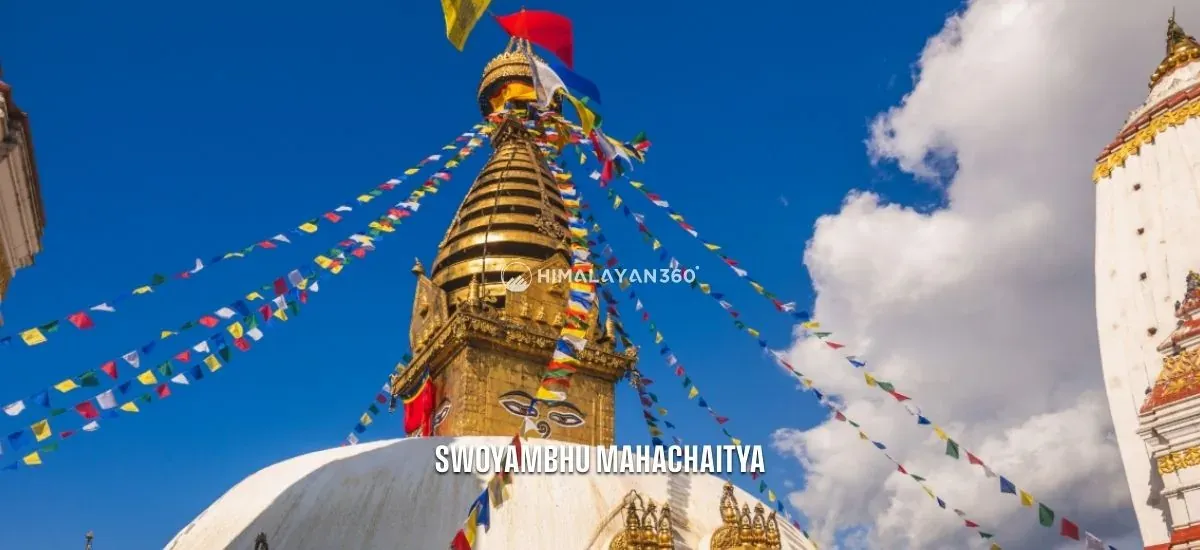
Two stupas in the Kathmandu Valley carry UNESCO status: Swayambhu, which UNESCO calls the oldest Buddhist monument in the valley, and Bauddhanath, which UNESCO calls the largest stupa in Nepal. Neither is a World Heritage Site in its own right. Both are monument zones inside a single inscribed property called Kathmandu Valley, listed in 1979, which is made up of seven such zones in total.
That distinction sounds pedantic until it wrecks your itinerary. People arrive expecting seven separate sites clustered in Kathmandu city, and find that three of the seven are not in Kathmandu at all.
This page sorts out what is actually inscribed, which of it involves stupas, and what genuinely fits into one day.
The Short Answer on Stupas in Kathmandu
| UNESCO stupas in the valley | Two: Swayambhu and Bauddhanath |
| Oldest | Swayambhu, described by UNESCO as the oldest Buddhist monument in the valley |
| Largest | Bauddhanath, described by UNESCO as the largest stupa in Nepal |
| The inscribed property | Kathmandu Valley, one property, seven monument zones |
| Year inscribed | 1979, under cultural criteria iii, iv and vi |
| Great stupa outside the property | Namobuddha, in Kavrepalanchok district, about 40km east of Kathmandu |
| Entry ticketing | Charged per site, tiered by nationality, no single valley-wide ticket |
The two words that cause the confusion are site and zone. Search results and tour listings both talk about the seven UNESCO sites of Kathmandu. UNESCO does not. Its own wording is that the Kathmandu Valley property is inscribed as seven Monument Zones, and the number of World Heritage Sites involved is one.
One Property, Seven Monument Zones
Here is the full list, in UNESCO's own grouping. Three are royal city centres, two are Buddhist stupa ensembles, and two are Hindu temple ensembles.
| Monument zone | Type | Where |
|---|---|---|
| Hanuman Dhoka, Kathmandu Durbar Square | Durbar square | Central Kathmandu |
| Patan Durbar Square | Durbar square | Lalitpur, south across the Bagmati |
| Bhaktapur Durbar Square | Durbar square | Bhaktapur, eastern valley |
| Swayambhu | Buddhist stupa ensemble | Hilltop west of central Kathmandu |
| Bauddhanath | Buddhist stupa ensemble | Northeast Kathmandu |
| Pashupati | Hindu temple precinct | Bank of the Bagmati, eastern Kathmandu |
| Changu Narayan | Hindu temple complex and Newari settlement | Ridge above Bhaktapur |
A few things worth knowing about that list. UNESCO notes that Pashupati has an extensive Hindu temple precinct and that Changu Narayan holds one of the earliest inscriptions in the valley, dating from the fifth century AD. The current boundaries are not the original ones: the seven zones as they now stand were established through a boundary modification accepted by the World Heritage Committee in 2006.
The property has also had a difficult history on the list. It was placed on the List of World Heritage in Danger from 2003 to 2007, the result of partial or substantial loss of traditional elements across six of the seven monument zones. UNESCO's own news archive records the Kathmandu property being removed from the Danger List on 25 June 2007. Domestically the zones are protected under the Ancient Monument Preservation Act of 1956, and managed under an Integrated Management Plan adopted in 2007.
What UNESCO praises is not any single building but the Newar craftsmanship running through all of it, which it dates to an apogee between 1500 and 1800 AD: tiered temples of fired brick and timber, roofs of small overlapping terracotta tiles, and carved windows, doorways and roof struts.
Swayambhu, the Oldest
Swayambhu sits on a hill west of central Kathmandu, and its claim is age. UNESCO's description of the property states that the religious ensemble of Swayambhu includes the oldest Buddhist monument, a stupa, in the valley. You will find a range of founding dates asserted elsewhere, some of them very confident and mutually incompatible, which is a good reason to hold on to the UNESCO phrasing rather than a specific year.
The nickname you will hear constantly is the Monkey Temple. That comes from the fact that the temple complex and hill site is home to families of wandering monkeys. Treat them as wildlife rather than scenery, and do not carry food openly.
The long eastern stairway that most visitors climb is a later addition to the site. It was built in the seventeenth century by Pratap Malla, the Malla king of Kathmandu, who left his mark across a great deal of the old city.
I have deliberately not given you a step count for that stairway. A specific number circulates widely and I could not verify it against a source worth citing, so it is not here.
Bauddhanath, the Largest
Bauddhanath, which you will equally often see written as Boudhanath or simply Boudha, is the other UNESCO stupa and the larger one. UNESCO states that the ensemble includes the largest stupa in Nepal. Wikipedia is more precise, calling it the largest spherical stupa in Nepal and one of the largest in the world, and notes that its layout is a massive mandala.
On dating, the sources are consistent about the uncertainty: the present structure was most likely built in the 14th century, while Newar chronicles mention a stupa on the site as early as the 5th century.
Bauddhanath makes far more sense once you know it sits on a road. It stands on the ancient trade route from Tibet to India, which enters the Kathmandu Valley at the village of Sankhu in the northeast, passes the smaller Charumati Stupa at Chabahil that people call Little Boudhanath, then turns south over the Bagmati towards Patan. Tibetan merchants stopped and prayed here for centuries before any tourist did.
The neighbourhood around it took its modern shape much more recently. Following the 1959 Tibetan uprising, large numbers of Tibetan refugees settled around the stupa, and that diaspora built the more than 50 gompas and monasteries that now ring it, along with the restaurants, guesthouses and artisan workshops. The circuit of the stupa is walked clockwise, and it is busiest and best at dusk.
Namobuddha and the Stupas Outside the Boundary
The UNESCO boundary is not the same thing as a list of important stupas, and Namobuddha is the clearest case. It is not a monument zone. It sits outside the valley altogether, in Kavrepalanchok district about 40km east of Kathmandu. Yet Wikipedia's Boudha entry groups it with Swayambhunath and Boudhanath as one of the most visited pilgrimage sites for devout Buddhists, and for pilgrims that grouping matters more than the inscription does.
Namobuddha is associated with the story of the Buddha, in a previous life, giving his body to a starving tigress and her cubs. Nearby stands the Thrangu Tashi Yangtse Monastery. Because it is a genuine drive out of the valley rather than a stop on a city circuit, it does not belong in a one day plan, which is why the three stupa tour near Kathmandu Valley gives it a full day of its own and keeps Swayambhunath and Bauddhanath for the second day. That is the honest shape of the trip: two days, because the third stupa is 40km away.
Worth remembering too that the valley is thick with smaller chaityas, votive stupas tucked into courtyards and street corners, most of them unlisted and uncounted. That is why the question of how many stupas Kathmandu has does not have a real answer.
What Actually Fits Into One Day
Both UNESCO stupas in one day is comfortable. All seven monument zones in one day is not.
The geography is the constraint. Swayambhu, Kathmandu Durbar Square, Pashupati and Bauddhanath are spread across Kathmandu city. Patan Durbar Square is over the river in Lalitpur. Bhaktapur Durbar Square and Changu Narayan are at the far eastern end of the valley, and those two really need a separate half day at least.
A realistic single day takes the two stupas plus two durbar squares. That is the shape of the Kathmandu day tour, which runs 09:00 to 17:00 and covers about 28km by private vehicle: Swayambhunath first, then Kathmandu Durbar Square, then Patan Durbar Square across the Bagmati, finishing at Bauddhanath. Four of the seven monument zones, both stupas, in eight hours.
If you have two days, add Bhaktapur and Changu Narayan on the second, since they are close to each other. If you have half a day, pick Swayambhu in the morning for the view over the valley, or Bauddhanath in the late afternoon for the circuit at dusk. Do not try to do both ends of the valley in one afternoon.
Entry Fees, and Why There Is No Number Here
This page will not tell you what entry costs, and the reason is worth stating.
What is reliable is the structure. Entry is charged per site, not as a single valley-wide heritage ticket, so visiting four monument zones in a day means paying four times. The Nepal Tourism Board publishes the official table, and it is tiered by nationality, with separate columns for foreign nationals, SAARC nationals, Chinese visitors and Nepalese visitors. Some sites also apply VAT, and children's rates differ.
What is not reliable is the amounts. Third party pages listing these fees contradict one another badly. In the course of checking this page, one operator's list gave Swayambhu as free entry while another gave a specific rupee figure for foreign nationals, and a third quoted two different figures for the same site inside a single sentence. Fees are also revised periodically, so pages go stale without being corrected.
So: check the Nepal Tourism Board's heritage site entry fee table close to your travel date, or ask whoever is guiding you. Carry Nepali rupees in cash, since ticket counters are not reliably card enabled. If a page gives you a precise figure with no date attached to it, treat it with suspicion.
Eating Between the Sites
The gap between Kathmandu Durbar Square and the northern half of the old city is filled by the thing the monument zones grew out of, which is trade. Asan is the best example. It is a ceremonial, market and residential square where six streets converge, and it straddles one of the two legendary India to Tibet trade routes through Kathmandu. The route runs diagonally through the old city, from Kathmandu Durbar Square up to Asan and on to the northeast, which is the same road that made Bauddhanath a stopping place.
Asan has been one of the city's main marketplaces since ancient times and has been described as a fine Newar example of a traditional Asian bazaar. What is sold there ranges from foodstuffs, spices and textiles through to electronics and bullion. Presiding over the square is the temple of Annapurna Ajima, goddess of abundant food grain and patron deity of the neighbourhood, who is represented not by a figure but by a filled grain measure. For a market square, that is about as apt as symbolism gets.
This corridor is where the eating is, and it is walkable in a way the stupas are not. The Kathmandu food tour covers about 6km on foot over four hours, running Thamel to Asan to Indra Chowk to Nardevi and back, built around Newar dishes: bara, chhoila, sekuwa, yomari, momo, samosa and lassi. It runs 14:00 to 18:00, which is the practical point, because it slots in after a morning of monuments rather than competing with one.
The Damage and the Rebuilding
Anything you read about these sites written before 2015 describes a different valley. The 25 April 2015 earthquake badly damaged Bauddhanath, severely cracking the spire, so that the entire structure above the dome, along with the sacred relics it held, had to be examined and either saved or replaced.
The rebuilding is the part worth knowing. Reconsecration began on 22 November 2015 with the ritual insertion of a fresh life tree, the central pole. All consecration relics were in place by 17 October 2016, followed by 21 days of rituals performed by senior representatives of the Kagyu, Sakya, Gelug and Nyingma traditions. The stupa reopened on 22 November 2016.
It was organised by the Boudhanath Area Development Committee, and according to the committee it cost about USD 2.1 million and more than 30kg of gold, funded entirely by private donations from Buddhist groups and volunteers rather than by the state. When you walk the circuit now, that is what you are walking around.
The durbar squares fared worse and their recovery has been slower and more uneven. Expect scaffolding, and expect individual temples within a zone to be closed even when the zone itself is open. Nothing on this page should be read as a guarantee that a particular building is standing and accessible on the day you turn up.
 Trek
Trek By air
 Pilgrimage
 Festivals
 Wildlife
 Luxury
 Yoga
Yoga Food
Food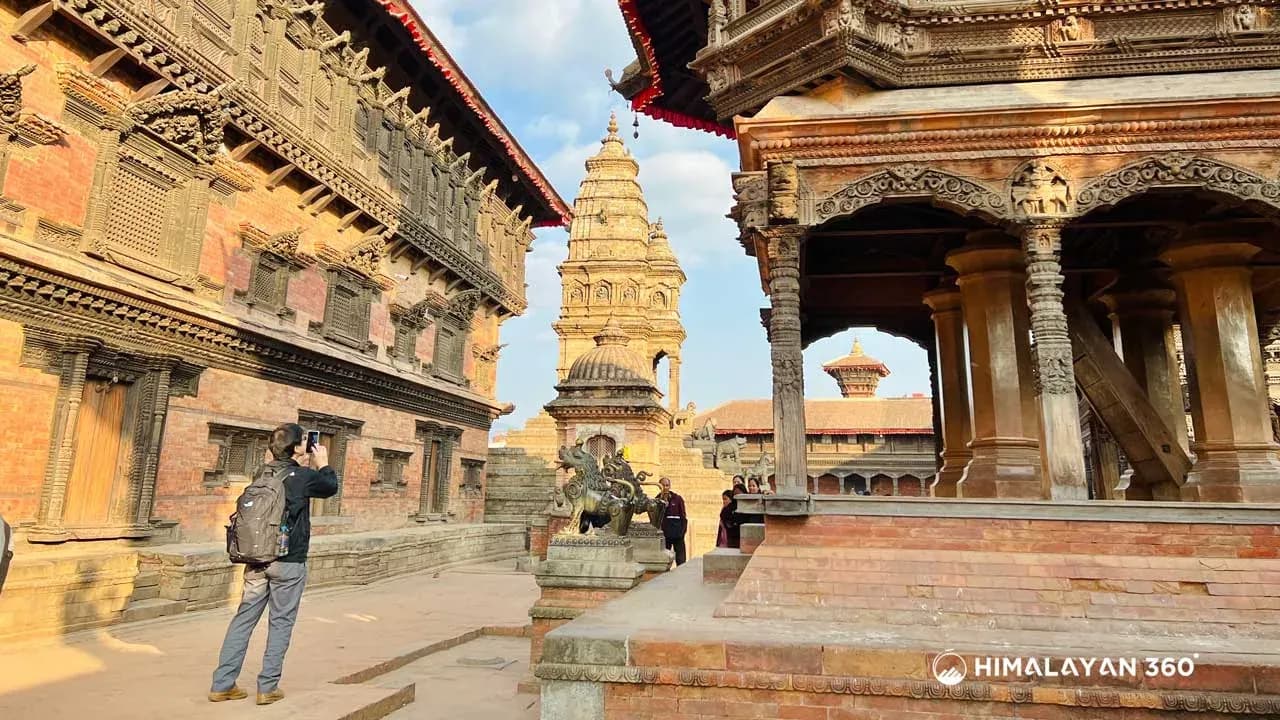 Heritage