
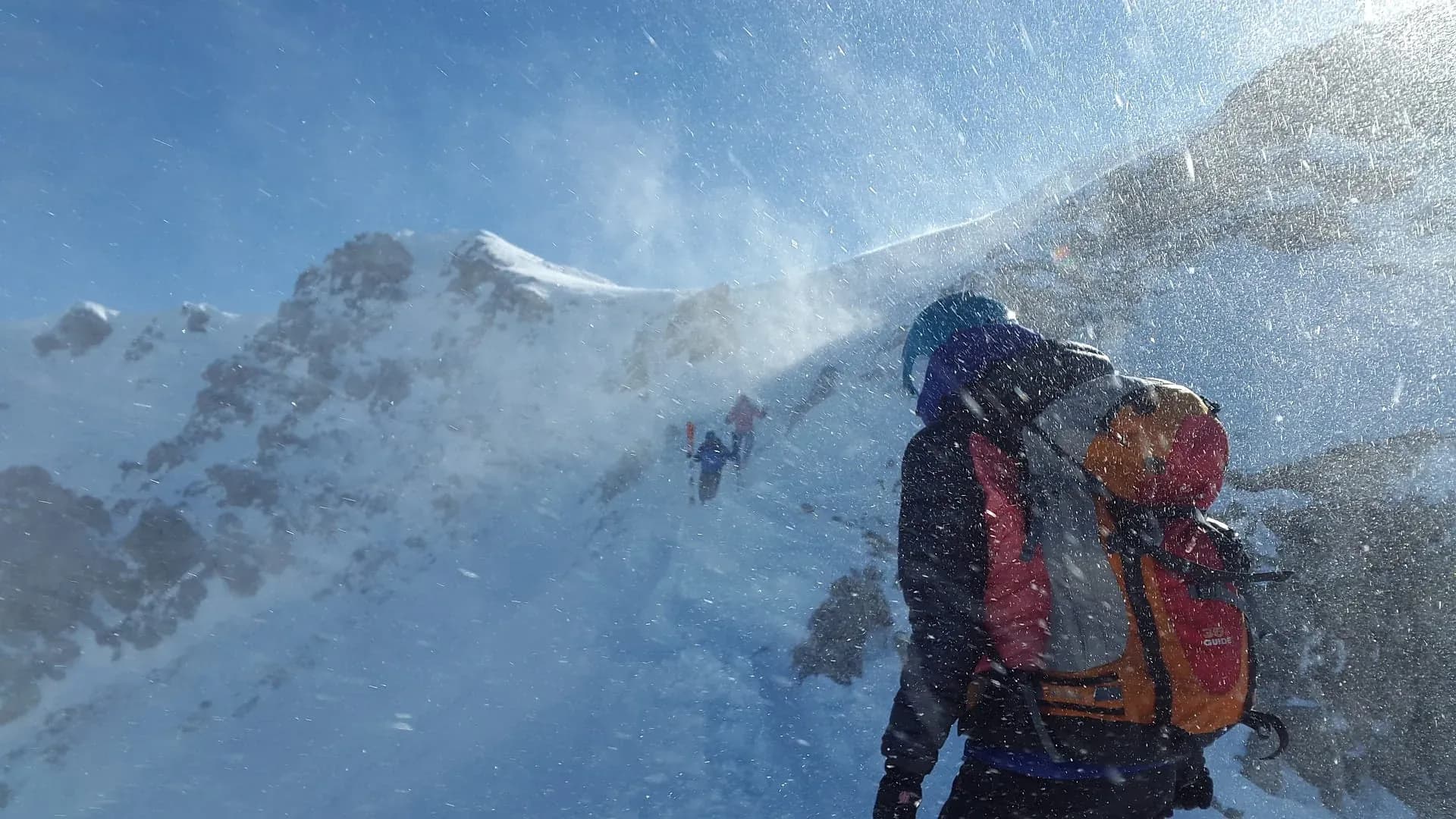
Cho Oyu is 8,188 m (26,864 ft), the sixth-highest mountain in the world, and a full expedition on it takes six to eight weeks. It stands on the Nepal and Tibet border in the Mahalangur range, a short distance west of Mount Everest, looking north over the Tibetan plateau, and is generally regarded as the least technical of the fourteen 8,000 m peaks. In older accounts it is simply the 6th highest peak, climbed as a rehearsal for bigger ones. That reputation is relative. It still demands proven high-altitude experience, competence with crampons and ice axe, and two months of tolerance for cold, wind and thin air.
Most of an expedition is not spent climbing. It is spent acclimatizing on rotations up and down the mountain, stocking higher camps, and waiting at base camp for a weather window that may or may not arrive. This page covers the seasons, the gear, the permits on both sides of the border, the difficulty, and an outline of what a Tibet-side itinerary looks like day by day.
| Height | 8,188 m (26,864 ft) |
| Rank | Sixth-highest mountain in the world |
| Location | Nepal and Tibet border, Mahalangur range, west of Mount Everest |
| Expedition length | Six to eight weeks, around 44 days on a typical Tibet-side itinerary |
| Best seasons | Spring (March to May), autumn (September to November) |
| Seasons to avoid | Monsoon (June to August), winter (December to February) |
| First ascent | 19 October 1954, northwest ridge, by Herbert Tichy, Joseph Jöchler and Pasang Dawa Lama |
| Technical grade | The least technical of the 8,000 m peaks, but not a beginner's mountain |
Cho Oyu is the sixth highest mountain on the planet, an 8,000 meter peak whose neighbour Everest is the highest peak in the world, and it carries more history than the summary suggests. Edmund Hillary was among the climbers on the British attempt on this mountain that came before his Everest expedition, and the Tibetan approach has been the standard one ever since it reopened. Cho Oyu is not a first Himalayan objective. If you have not yet climbed above 6,000 m, the sensible route to it runs through Nepal's trekking peaks and a full Everest Base Camp trek first, which is covered further down this page.
How Long Does a Cho Oyu Expedition Take?
A Cho Oyu expedition usually takes around six to eight weeks. In the beginning, climbers spend a few weeks getting used to the high altitudes by going up higher and higher. Then they set up a central camp, where they keep their supplies. After that, they make stops at camps higher up the mountain, like resting points. The main part of the expedition is when they try to reach the summit, usually waiting for good weather. Once they make it to the top, they come back down to lower camps, and eventually, they go back to lower elevations.
The length of the expedition can change based on things like the weather and the plan of the climb, but these stages are what climbers typically go through when trying to reach the top of Cho Oyu.
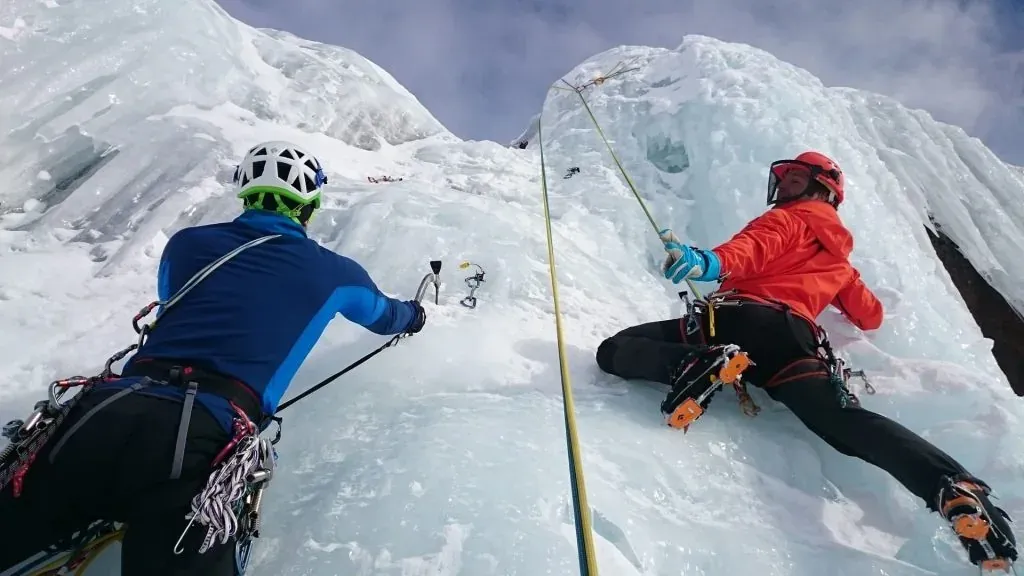
Best Time to Climb Cho Oyu
The best time to climb Cho Oyu is during the pre-monsoon spring season and the post-monsoon autumn season. These two periods offer more favorable weather conditions, making the climb safer and more feasible.
Spring Season (March to May)
Spring is the most popular and preferred season on the mountain. The weather during this period is relatively stable and favorable for climbing. The skies are clearer, offering better visibility, and the days are longer, allowing for more climbing hours. The snow conditions are usually better, making it easier to navigate the mountain.
Autumn Season (September to November)
The autumn season is another excellent time to be here.
The weather is typically stable, with clear skies and good visibility, similar to the spring season. The temperatures are moderate, which can make climbing more comfortable. Crowds are usually smaller in the autumn compared to the spring.
Seasons to Avoid on Cho Oyu
While autumn and spring are the best seasons to climb, there are certain seasons to avoid in order to ensure a successful ascent.
Monsoon Season (June to August)
The monsoon season is the least favorable time to be on the mountain. During these months, the region experiences heavy and continuous rainfall, particularly in the lower elevations. This leads to unstable and hazardous conditions, including landslides, washed-out trails, and dangerous river crossings. The monsoon season makes climbing extremely challenging, and it is generally not recommended.
Winter Season (December to February)
Climbing Cho Oyu during the winter months is also discouraged. The winter season in the Himalayas brings harsh conditions, including freezing temperatures, heavy snowfall, and strong winds. These extreme weather conditions make climbing Cho Oyu difficult and dangerous. Avalanches become a significant risk, and the mountain is typically not climbed during this period.
Essential Gear and Equipment for Climbing Cho Oyu
Climbing Equipment
- Climbing Helmet
- Crampons
- Climbing Harness
- Ice Ax
- Multi- Led headlamp
- Ascender
- Locking and non-locking Carabiners
- Ski poles
- Rappel/ Belay device
- Slings
- Ropes
- Lightweight pulleys
- Prusik Cords
- Avalanche Transceiver
Upper Body Cloths
- Lightweight Merino t-shirt
- Lightweight Merino long-sleeve t-shirt
- Medium-weight fleece pullover
- Fleece jacket
- Breathable and Waterproof jacket with a large hood that can fit the helmet
- Lightweight down jacket
- Warm down/ duvet suit
- Lightweight thermal base layers
Lower Body Cloths
- Lightweight underwear briefs
- Walking shorts
- Walking trouser
- Lightweight thermal bottoms
- Heavy thermal bottoms
- Fleece trouser
- Waterproof and breathable trousers with full side zips
- Warm down/ duvet bibs
Handwear
- Lightweight poly-liner gloves
- Medium weight gloves
- Warm fleece mitt liner paired with over mitt
Headwear
- Synthetic or warm wool hat that covers the ears
- Scarf, buff, or neck sleeve
- Head Scarf or Bandana
- Balaclava
- Sun cap/ hat
- Face mask
- Ski goggles (light or dark lens optional)
- Eyes and nose coverage eyewear
- Glacier sunglass
Footwear
- Medium or heavy wool or poly socks
- Poly or wool Liner socks
- Lightweight trekking socks
- Lightweight wool or cotton socks
- Overboot or good quality plastic shell Aveolite liners with inner boot
- Sturdy synthetic or leather hiking boots with good ankle
- Cross trainers or running shoes
- Down boot (optional)
Travel Bags
- Medium rucksack (3000- 4500 cubic inches/ 50- 70 liter)
- Large waterproof duffle kit bag (7500 cubic inch/ 120 L)
- Pack cover
- Small and protective padlocks
Sleeping Gear
- Down sleeping bag for high altitude (rated to handle -35 / -30 )
- Additional sleeping bag for base camp (rated to handle -20 / -30)
- Closed-cell foam mat for base camp and high-altitude
Personal Hygiene
- High SPF Sunscreen
- Moisturizer
- Body lotion
- Anti-mosquito cream
- toothbrush/ paste set
- Hand sanitizer
- Synthetic towel
- Wet Wipes and toilet paper
- Bar soap
First-aid Kit
- Small personal kit including aspirin, band-aids, tape, personal medication, etc
- Personal medication with prescription
- Skin blister repair kit
- Small bottle of anti-diarrhea pills
- A small bottle of anti-headache pills
- A small bottle of cough medicine
- Water treatment tablets
- Water filters
- Antibiotics for chest or stomach
Permits Required to Climb Cho Oyu
The permits you need depend on whether you are approaching from the Tibet (China) side or the Nepal side. Here are the typical permits needed for a Cho Oyu climb:
- For the Tibet (China) Side:
Chinese Mountaineering Association (CMA) Permit
This is the primary permit required for climbing Cho Oyu from the Tibet side. You need to obtain this permit through the CMA, and it covers climbing Cho Oyu.
Tibet Entry Permit
This permit is required for foreign travelers to enter Tibet and is usually arranged through a travel agency or tour operator in Tibet.
Aliens’ Travel Permit
In addition to the Tibet Entry Permit, an Aliens’ Travel Permit may be necessary to visit certain restricted areas within Tibet. Check with local authorities or your tour operator to confirm if this permit is needed.
- For the Nepal Side:
Nepal Mountaineering Association (NMA) Permit
Climbers attempting Cho Oyu from the Nepal side need a climbing permit issued by the Nepal Mountaineering Association. The NMA oversees climbing permits for various peaks in Nepal, including Cho Oyu.
Trekkers’ Information Management System (TIMS) Card
While it’s not always mandatory for Cho Oyu climbers, a TIMS card might be required if your expedition involves trekking through the Khumbu region.
Sagarmatha National Park Entry Permit
If your route through Nepal includes areas within Sagarmatha National Park, you’ll need an entry permit for this park.
Visa and Passport
Ensure you have a valid passport with at least six months of remaining validity and the appropriate tourist visa for Nepal.
Climbing Insurance
Many expedition companies and local authorities may require you to have climbing insurance that covers the cost of rescue and medical treatment in case of emergencies.
What Makes the Ascent of Cho Oyu Difficult
Climbing Cho Oyu is tough but doable. It’s not the hardest mountain, but it’s still really high, and that makes it challenging. You need to get used to the high altitude, which can make you sick if you’re not careful. You also need to know how to use your climbing gear, especially on the snowy and icy parts. The weather can be very cold and windy, and there’s a risk of avalanches in some areas. The climb takes about two months, and you need to stay strong and healthy. So, it’s not easy, but many climbers join guided expeditions with experts to make it safer.
What a Cho Oyu Climb Actually Involves
Cho Oyu is the 6th highest mountain on earth, and the standard route up it is a long walk on snow slopes with a short technical section in the middle. That is why it has the reputation it does, and why it is paired so often with its neighbour. Cho Oyu and Shishapangma are the two mountains most often sold as a first 8000m climb, and both are approached from the Tibetan side of the border.
Nobody arrives here cold. Most people on the mountain have a 6,000 m or 7,000 m Himalayan peak behind them, and often something like Aconcagua or Denali as well, which is to say several seasons of high-altitude climbing rather than a good year in the gym. The international mountain guides who run these trips screen for exactly that. A fully guided expedition on Cho Oyu is a team operation: an expedition leader, climbing Sherpas, cooks and yak herders, and a group of expedition members whose main job for the first month is to acclimatize rather than to climb.
Base Camp, Advanced Base Camp and the Higher Camps
On the Tibet side the road reaches Chinese Base Camp, and yak trains carry loads from there up the moraine to advanced base camp. That is where an expedition team actually lives. Everything above advanced base camp is tents, and the higher camps are stocked in stages: a climb to camp 1, a night, back down; then higher, then down again. This is the rhythm that eats the weeks, and the reason the 6th highest mountain still needs six to eight weeks rather than two, however straightforward the climbing is.
Above the camps the ground is snow and ice, long slopes broken by one steep step, an ice cliff that is the only part of the standard route needing real technique. Fixed line is normally in place there and on the exposed sections above it, and Sherpa support carries the rope, the tents and the bottled gas that makes a high camp habitable. Most climbers use supplemental oxygen from the upper camps onwards.
Sherpa Support and Supplemental Oxygen
No commercial team on this mountain works without climbing Sherpas. They fix the line, carry the loads that make the high camps usable, and are usually the people who decide, in practice, whether the weather window is real. Bottled gas is normal from the upper camps up, and an expedition that promises a summit without either of those things is promising something it cannot deliver.
How Cho Oyu Compares with an Everest Expedition
An Everest expedition is longer, colder, far more expensive and technically harder in the icefall, but the shape of the two trips is the same: rotations, waiting, one long summit push. Mount Everest is a short distance east and visible from the top of this one, which is why so many people treat a Cho Oyu season as the rehearsal. The honest difference is margin. On Everest the consequences of a slow day are much worse.
Summit Day on Cho Oyu
The summit climb starts in the dark from high camp and it is long, cold and unrelenting rather than difficult. The final ground is a broad summit plateau, wide enough that the Cho Oyu summit is not obvious in poor visibility, which is one reason honest teams turn people around short of it. From the top the view runs across the great Himalayan peaks: Everest and Lhotse to the east, Ama Dablam beyond them, and the brown expanse of the Tibetan plateau to the north.
Once climbers have summited, the descent to advanced base camp is done in a day if the weather holds, and the walk back to Kathmandu or the drive out through Tibet takes the remaining days on the itinerary. Cho Oyu mountain never pretends to be the highest in the world, but a trip of this length asks for a tolerance that no single hard day can teach you.
Outline itinerary
Day 1: Arrival in Kathmandu
Day 2: Kathmandu sightseeing & expedition preparation
Day 3: Scenic flight to Gongkar Airport, Lhasa
Day 4: Full-day Lhasa sightseeing
Day 5: Drive to Gyantse
Day 6: Drive to Xigatse
Day 7: Drive to Tingri
Day 8: Acclimatization day at Tingri & short hike
Day 9: Drive to Chinese Base Camp
Day 10: Acclimatization & preparation for the expedition
Day 11: Trek to middle camp
Day 12: Trek to Ad. Base Camp of Cho Oyu
Day 13-39: Climbing period- Summiting Mount Cho Oyu
Day 40: Trek back to middle camp & return drive to Tingri
Day 41: Drive back to Xigatse
Day 42: Scenic flight/drive to Lhasa
Day 43: Scenic flight to Kathmandu
Day 44: Final departure
How to Build Up to an 8000m Peak in Nepal
Himalayan 360 does not run Cho Oyu expeditions, and the honest advice for anyone reading this page without 8,000 m experience is that the mountain is the end of a progression, not the start of one. The useful ladder in Nepal looks like this.
- Get high on foot first. The Everest Base Camp Trek tops out at Kala Patthar, 5,545 m, and tells you honestly how your body behaves above 5,000 m. That answer is worth more than any training plan.
- Learn the hardware on a trekking peak. Island Peak Climbing at 6,189 m and Lobuche East Peak Climbing at 6,119 m are where crampons, harness, jumar and fixed ropes stop being theory. The Island Peak itinerary builds in a pre-climb training session at base camp.
- Add altitude and duration. Mera Peak Climbing at 6,476 m is the highest and longest of the three. Our vital tips before climbing Mera Peak set out what that climb actually asks of you.
- Fix the altitude side before anything else. Every expedition failure at this height traces back to how fast someone went up. Read altitude sickness prevention and treat the ascent profile as the plan, not a detail of it.
Do those in order and an 8,000 m permit becomes a reasonable conversation with a specialist expedition operator. Skip them and Cho Oyu's reputation as the easiest of the fourteen will not help you.
 Trek
Trek By air
 Pilgrimage
 Festivals
 Wildlife
 Luxury
 Yoga
Yoga Food
Food Heritage