
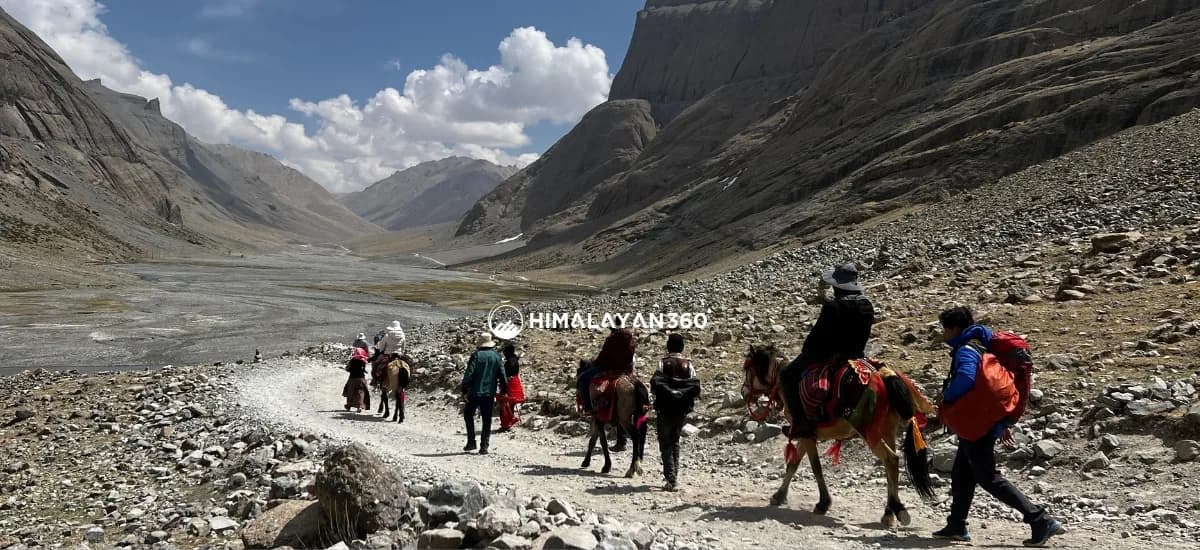
They say Mount Kailash is so sacred that even Google Maps refuses to give you a detailed route! Mount Kailash is not just a normal mountain. It is a mountain located in the remote far west of the Tibet region of China, Mount Kailash stands at an elevation of 6,638 m, and it is considered holy by Hindus, Buddhists, Jains, and Bon followers. Mt Kailash rises north of the main Himalayas on the dry plateau of western Tibet, and it has stayed shrouded in mystery for as long as people have written about it.
Surprisingly, no one has ever officially climbed it because of its religious significance, which makes it one of the few untouched peaks in the world. Pilgrims from across Asia still make the kora (circumambulation) trek around the mountain, which is about 52km long, to pay their respects, and that walk is what a Kailash pilgrimage means in practice. To give you a closer look at this sacred site, here are 10 interesting facts about Mount Kailash that may excite you even more.
Mount Kailash Quick Facts
| Elevation | 6,638 m |
| Location | Ngari Prefecture, Tibet Autonomous Region, China |
| Range | Gangdise Range, part of the Trans-Himalaya |
| Sacred to | Hinduism, Buddhism, Jainism and Bon |
| Summit status | Never climbed. No climbing permits are issued |
| Outer kora | 52 km, walked over three days from Darchen |
| Highest point on the kora | Dolma La Pass, 5,630 m |
| Lake Mansarovar | Freshwater, 4,590 m |
| Lake Rakshastal | Saline, no fish |
| Rivers rising nearby | Indus, Brahmaputra, Karnali, Sutlej |
| Best season | May to September |
1. The Pyramid-like Structure of Mt Kailash
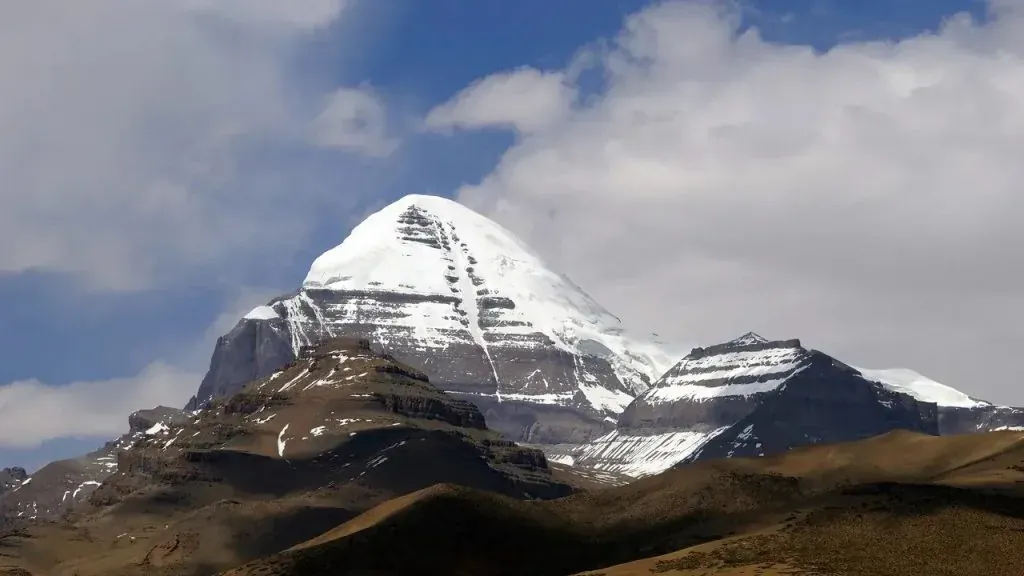
Mount Kailash, a sacred mountain in the Kailash range of Tibet, is famous for its pyramid-like structure. Unlike many other peaks, Kailash has a near-perfect symmetrical shape with four distinct faces rising vertically. Mount Kailash’s four faces each align with the cardinal directions – north, south, east, and west. In 1953, Swiss geologist Augusto Gansser-Biaggi noted that the peak consists mainly of metamorphic rocks, including gneiss and granites, which have survived millions of years of erosion.
The pyramid-like structure of Mount Kailash also has cultural and religious significance. Many believe the shape of the mountain symbolizes a link between heaven and earth. Mount Kailash is considered a sacred mountain by Hinduism, Buddhism, Jainism and Bon alike, and pilgrims from all four perform rituals around its base. No other mountain in Tibet is read this closely for meaning, and few of the physical features of Mount Kailash go undiscussed, and the peak of Mount Kailash is the point almost every pilgrim on the plateau orients towards. The combination of its pyramid-like structure, geological stability, and sacred status makes Mount Kailash a spiritual landmark in the Kailash range.
2. Mount Kailash Is the Axis of the Universe and the Mythical Mount Meru
Mount Kailash, often referred as the Axis of the Universe, holds a central place in the spiritual geography of the world. Over centuries, this mountain has been a reference point for mapping the region, which gives it its symbolic role as the “Axis of the Universe“. On that mental map Mount Kailash is the axis and everything else is arranged around it. Across multiple religions, including Hinduism and Buddhism, it is identified with the mythical Mount Meru. Mount Meru is the holy mountain believed to be the centre of all physical, spiritual, and cosmic realms, so in cosmological terms Mount Kailash stands at the center of the universe rather than as one peak among many.
For Hindus, the mountain is the abode of Lord Shiva, and calling it the home of Lord Shiva is not a figure of speech to a pilgrim but a statement of address. It is a dwelling place of Lord Shiva rather than a shrine to him, and the mountain is considered sacred for that reason alone. In Tibetan Buddhism it is the seat of Demchok, also known as Chakrasamvara. That shared status puts Mount Kailash at the center of the world for several traditions at once, which is why pilgrims on the Kailash Mansarovar Yatra come to perform the circumambulation of Mount Kailash rather than to look at it from a distance.
3. Origin of Four Major Rivers: Indus, Bhramaputra, Karnali, and Sutlej
Mount Kailash is the source of four of the major rivers of Asia: the Indus, Brahmaputra, Karnali, and Sutlej. That makes it a hydrological landmark as well as a spiritual one. All four are treated as sacred rivers along their whole length. These rivers are considered lifelines for millions of people in Tibet, India, and Nepal. The Indus flows northwest into Pakistan, the Brahmaputra travels east into India and Bangladesh, the Karnali moves south into Nepal before joining the Ganges, and the Sutlej flows west into India and Pakistan.
Geologically, the rivers rise from the glaciers surrounding Mount Kailash, including the Gangdise and Lipu Lekh glaciers, which remain untouched due to the remote location of the mountains. Nothing else near Mount Kailash feeds a river system on this scale. The hydrological network of these rivers supports the ecosystem and agricultural regions across multiple countries.
4. Resemblance of Lord Shiva’s Third Eye and Nandi
Many Pilgrims and researchers have pointed out that the formation of Mount Kailash resembles the symbol linked with Lord Shiva. On the southern face of the mountain, a vertical cleft has been described as the third eye of Shiva, which symbolizes cosmic vision in Hindu belief. This connection proves that the mountain is not just a geological structure but a sacred peak with spiritual meaning.
Alongside the third eye resemblance, the outline of the mountain from a different angle is said to resemble Nandi. Nandi is considered the guardian and vehicle of Lord Shiva, and his symbolic presence adds more spirituality to Mount Kailash. While science identifies these as natural erosion patterns of metamorphic rock, they are not formations caused by divine power or myths.
5. No Climber Is Ever Allowed to Climb Mount Kailash
Mount Kailash remains one of the few mountains in the world that cannot be climbed, and no permits are granted for ascending it. The Chinese government strictly prohibits any climbing activity to respect the religious beliefs of Hindus, Buddhists, Jains, and Bon followers who consider the mountain sacred. While trekking around Kailash is allowed, the summit itself is untouched. These strict restrictions make sure that Mount Kailash maintains its pristine condition.
Put plainly, Mount Kailash has never been climbed. No climber holds a summit claim on it, and none is likely to, because the permission to try does not exist. The contrast with Mount Everest is stark: Everest has a queue on it every spring, while nobody may climb Kailash at all. A request to climb Mount Kailash is refused at the permit desk rather than on the slope, so the decision not to climb the mountain is a legal and religious one rather than a mountaineering one.
Despite the ban on climbing, pilgrims can still do the Kailash Mansarovar Yatra, a journey that allows devotees to circumambulate the mountain and visit Lake Mansarovar. This circumambulation, called “parikrama‘ or “kora,” is a spiritual practice believed to cleanse sins and bring blessings. Legal rules, religious respect, and natural protection make Mount Kailash a sacred peak that cannot be climbed but is open to pilgrims for worship at its base.
One point is often misread here. No permit exists for the summit, but the journey to the base needs several. Every visitor travels on a Chinese Group Visa plus a Tibet Travel Permit and an Alien's Travel Permit for the restricted Kailash zone, all arranged by a registered operator, because independent travel into the region is not allowed. See how to get a Tibet travel permit for what the paperwork involves.
6. Kailash Region Experiences Accelerated Aging
Mount Kailash is located in a region where extreme altitude, harsh climate, and ultraviolet radiation accelerate aging for both humans and equipment. The high elevation of the mountain contains a lower oxygen level and exposes the area to stronger UV radiation. This can lead to faster physical fatigue, reduced skin elasticity, and other altitude-related aging effects like dry skin and chapping.
Pilgrims and travelers doing the Kailash Mansarovar Yatra often report feeling physically older after even a few days of trekking. The cold temperature (around -5°C), strong winds, and dry air further increase the strain on the body. However, it has little effect on the physique, and anyone who wants to experience its beauty can go for the Mount Kailash and Lake Mansarovar yatra without hesitation.
7. Hidden Energy of Mount Kailash Discovered by NASA
This mountain has been an interesting subject for both religious seekers and scientists. NASA satellite scans detected electromagnetic radiation emitting from Mount Kailash. These emissions are so intense that they have caused the compass to spin uncontrollably and disrupted electronic devices. Such anomalies have led to the belief in a hidden energy in the mountain, an “Earth Chakra” radiating force that affects both the physical and metaphysical regions.
Also, in 2016, the Terra spacecraft of NASA captured high-resolution images of the mountain. It showed the pyramidal shape of the mountain, which is similar to another ancient structure, like the pyramid of Giza and Stonehenge. This information created debates about the origin of the mountain. Some researchers even speculate that Mount Kailash could be a man-made vacuum pyramid, surrounded by over 100 smaller pyramids.
8. Lake Manasarovar and Lake Rakshastal, the Yin and Yang Lakes
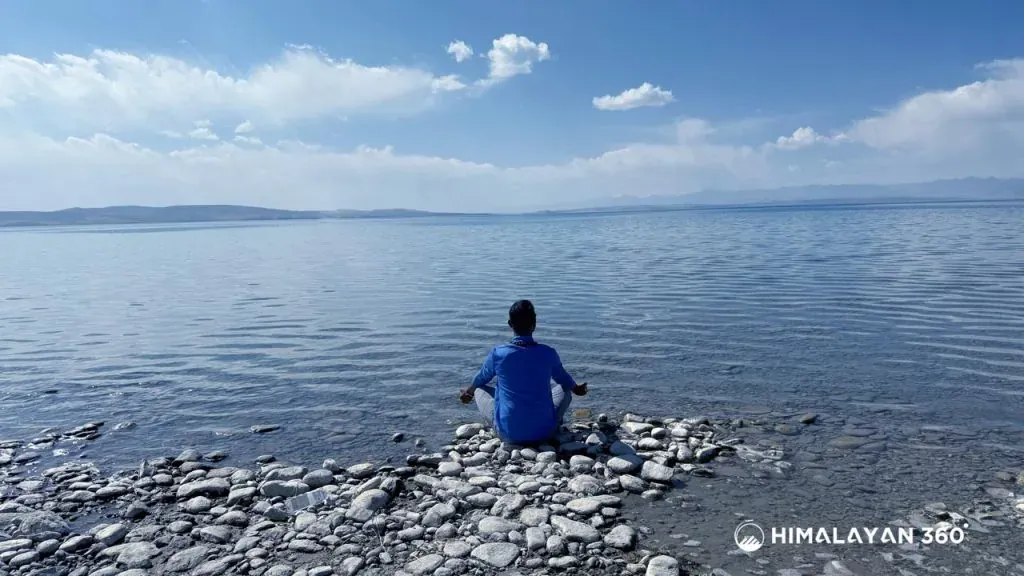
Kailash Mountain is surrounded by two lakes that are often called the Yin (Lake Mansarovar) and the Yang Lakes (Lake Rakshastal). Yin and Yang are two Chinese words that mean purity (Yin) and darkness (Yang). Lake Mansarovar is a freshwater lake located to the south of the mountain. It is one of the highest freshwater lakes in the world, sitting at an altitude of 4,590 m. Pilgrims consider it sacred and perform ritual baths during the Kailash Mansarovar Yatra.
To the north of Mount Kailash lies Lake Rakshastal, a saltwater lake. Unlike Mansarovar, it has high salinity and is lifeless for fish. Lake Mansarovar is also spelled Lake Manasarovar in older texts and on many Indian maps, so the pair turns up as Lake Manasarovar and Lake Rakshastal in a good deal of yatra literature. The two are connected by underground channels, according to the locals’ beliefs. Their closeness to the sacred peak makes the lakes very special for pilgrims and travelers.
9. No Permanent Settlement Around Mount Kailash
The region around Mount Kailash has no permanent settlements. Extreme weather, cold temperatures, and high altitude make it very difficult for people to live here year-round. Temperatures can drop below -20°C in winter, and oxygen levels are low due to the altitude of over 4,000 meters. These condition causes physical stress and aging for anyone staying too long.
However, temporary shelters are used only during the Kailash Mansarovar Yatra or short scientific expeditions. The lack of permanent human inhabitation preserves the natural and mystical environment of the mountain. The sacred peak remains preserved, keeping its spiritual beauty intact.
10. Limited Wildlife in This Corner of Western Tibet
The region around Mount Kailash has very limited wildlife. The extreme altitude and low oxygen level make it difficult for most animals to survive. Few mammals like yaks, Tibetan antelopes, and wild sheep are found only in lower areas. Birds are rarely seen flying directly above the peaks. Some local myths say even eagles and other birds avoid the sacred mountain, increasing its spiritual charm.
Plant life is also sparse due to the rocky terrain and freezing temperatures. Glaciers and snowfields occupy the landscape, leaving little space for vegetation. However, plants like Snow Lotus (Saussurea), Kasturi Kamal, and Meconopsis are still found. The lack of permanent wildlife and difficult conditions show how Mount Kailash remains untouched by human and animal activity.
Mount Kailash Is Not Adi Kailash
Mount Kailash and Adi Kailash are two different mountains, and the two names get mixed up constantly. Mount Kailash is the 6,638 m peak described on this page, inside Ngari Prefecture in the Tibet Autonomous Region of China. It is the mountain circled on the 52 km kora, and the one paired with Lake Mansarovar.
Adi Kailash, also called Chota Kailash, is a separate peak in the Pithoragarh district of Uttarakhand in India, reached overland from Dharchula. It is an Indian-side journey that never crosses into Tibet, so it needs no Chinese Group Visa and no Tibet Travel Permit. Every yatra described on this site goes to Mount Kailash in Tibet. If you are looking for the Uttarakhand peak, this is not that trip.
Mount Kailash Kora, Charan Sparsh, and Lake Mansarovar Yatra
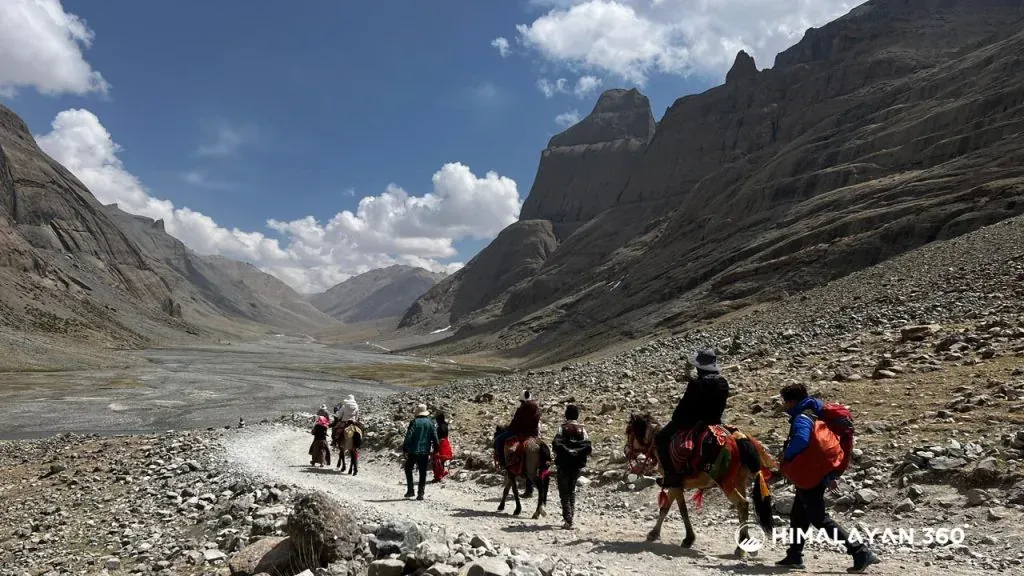
The Kailash parikrama, the 52 km loop Tibetans call the kora, is the whole point of the trip for most pilgrims. Hindus, Buddhists and Jains all revere the circuit as a way to shed the weight of past actions. Buddhists frame the reward as enlightenment, Hindus and Jains as liberation, and every tradition holds that a pilgrim who walks it with the right intention can attain something no amount of reading will give. The direction of travel differs by faith, but everyone starts and finishes at Darchen, at the base of Mount Kailash.
Getting there is its own undertaking. There is no road to the summit and no cable car. The route to Kailash runs overland from Kathmandu through the Kerung border, overland from India through Lipulekh or Nathu La, or by helicopter from Simikot, and whichever Kailash tour you pick, the last stretch is walked. Our Kailash Mansarovar Yatra route guide sets the options side by side, so you can price a Kailash trip before you commit to one.
The journey to Mount Kailash is not only about Himalayan beauty but also about experiencing special routes like the Mount Kailash Charan Sparsh. This short Kailash trek takes you to the foot of Mount Kailash, where you can feel spiritually connected, touching the “feet” of the mountain. Alongside this, the Lake Mansarovar Yatra holds religious value. You can take a holy dip in the lake, believed to cleanse faults and bring blessings.
When planning the sacred journey, being well-prepared is very important. From warm clothing and medical essentials to spiritual offerings, everything should be covered. A detailed packing list for Kailash Mansarovar Yatra is included in our package to help you stay safe and comfortable in the high-altitude region. Grab the Mount Kailash tour package and start your spiritual journey with us.
Best Time to Visit Kailash, Season by Season
The best time to visit Mount Kialash is from May to Sept, when the weather is mild, and the routes are open for pilgrims. Here is the overall climate condition for Mount Kailash Yatra.
| Season | Weather Condition | Average Temperature (Day / Night) |
| Spring (Mar to Apr) | Cold, snow still present, risky for trekking | 3 to 5°C / -8 to -10°C |
| Summer (May to Sept) | Mild and clear, ideal for trekking and pilgrimage | 12 to 15°C / -5 to 2°C |
| Autumn (Oct to Nov) | Cool and clear, shorter days, routes start closing | 8 to 10°C / -4 to -2°C |
| Winter (Dec to Feb) | Extremely cold, heavy snow, inaccessible | -5 to -15°C / -20 to -25°C |
Conclusion
Hence, Mount Kailash is a magical and sacred peak in Tibet, worshipped by Hindus, Buddhists, Jains, and Bon followers. Known as the Axis of the Universe, it is the source of major rivers like the Indus, Brahmaputra, Karnali, and Sutlej. The importance of Mount Kailash comes from that overlap: one mountain that four faiths read as the same centre. Mount Kailash holds a unique position for that reason, with no real parallel anywhere else in the Himalayas. Its pyramid-like shape, its religious weight and the emptiness around it make it one of the most mysterious mountains in the world, and the mystery of Mount Kailash survives precisely because nobody is allowed to go up and settle the question.
 Trek
Trek By air
 Pilgrimage
 Festivals
 Wildlife
 Luxury
 Yoga
Yoga Food
Food Heritage