
A Tibet Travel Permit, also known as Tibet Entry Permit, is a permit issued by the Tibet Tourism Bureau, and you cannot apply for it yourself. A registered tour operator in Tibet or in Nepal applies on your behalf using a scanned colour copy of your passport and a confirmed day-by-day itinerary, and the process usually takes 15 to 20 days. The permit itself is free. What you pay is the agency service fee.
You need this travel permit to visit Tibet whichever way you arrive, and depending on your route one or more further travel permits sit on top of it. This guide covers the permit process from the Nepal side: what a Nepal to Tibet trip needs, how to get the Tibet Travel Permit, and which Tibet permits you may need beyond it. Every Tibet journey starts with the same piece of paper, a permit issued by Tibet Tourism Bureau, and ends with however many travel permits your route adds to it.
Two rules shape everything else. Independent travel in Tibet is not allowed, so the permit only exists alongside a booked tour and a licensed Tibetan guide. And the permit is location-specific: you are only allowed to travel to the places named on it, so if you want to travel beyond Lhasa the itinerary has to be settled before the application goes in rather than after. Anyone planning to travel to Tibet should treat the travel plan and the permit application as one job rather than two.

Who requires a Tibet Travel Permit?
You need a Tibet Travel Permit to visit any part of the region, whether you are a foreign tourist planning to see Lhasa or to travel anywhere else within Tibet, as required by the laws of the People’s Republic of China. It is the document that lets you board a flight or cross the border into the region, and should the permit be checked at a road checkpoint and not be there, you are turned back on the spot. To obtain the Tibet Travel Permit you must book your tour through a licensed travel agency, which handles the application. Which further travel permits are required on top of it depends entirely on where you are going.
Three categories exist, and the third catches people out. Diplomats, journalists and serving government officials cannot be issued a tourist permit at all, because their travel is handled through separate official channels rather than the Tourism Bureau. The Bureau will not issue a Tibet Travel Permit against those occupations, so the travel permits have to be arranged another way entirely. Declaring the wrong occupation on the form is the most common reason an application comes back rejected.
| Need | Don’t Need | who can’t get |
| International tourists | Residents of HK SAR | Diplomat |
| Chinese Living in Taiwan | Residents of Macau SAR | Journalist |
| Overseas Chinese with Chinese ID | Government Officials | |
| Indians Visiting Ngari |
How to Apply for a Tibet Travel Permit?
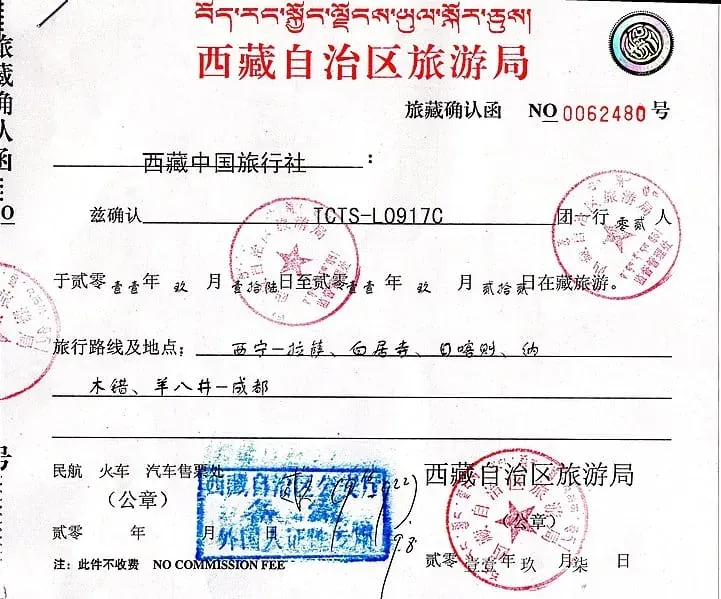
Sample of a Tibet Travel Permit/Tibet Entry Permit (By 西藏自治区旅游局 / Tourism Bureau of Tibet Autonomous Region – 西藏中国旅行社 / Tibet China Travel International LTD., Public Domain_)_
Unlike a regular Chinese visa application, the permit process must be coordinated with the Tibet Tourism Bureau through a licensed travel consultant working with a local Tibet operator in Lhasa. You cannot apply for the Tibet Travel Permit at a Chinese embassy, and a local travel agency in your own country cannot file it for you either. If you’re planning to explore the mesmerizing landscapes and rich cultural heritage of Tibet, you’ll need to navigate this permit application journey.
Here’s a step-by-step guide on how to apply for a Tibet Travel Permit:
- Contact a Registered Tibet Travel Agency
- Plan Your Tibet Itinerary: ie. Kailash Mansarovar Yatra
- Share Personal Information
- Confirmation Letter
- Permit Application Submission
- Receive Your Tibet Travel Permit
Documents Required for Tibet Travel Permit Application:
The travel documents split into two piles: the scans your operator needs in order to apply for your Tibet travel permits, and the originals you carry on the day.
Valid Passport
- Your passport must be valid for at least six months from your planned entry date into Tibet.
Chinese Visa/Chinese Group Visa:
- If you are entering Tibet from other parts of China, you’ll need to apply for a Chinese Visa from the Chinese Embassy in your home country.
- If you plan to enter Tibet from Nepal, you’ll be required to obtain a Chinese Group Visa from the Chinese Embassy in Kathmandu, Nepal. It’s essential to note that a Chinese Group Visa is necessary when entering Tibet from Nepal.
- If you already possess a Chinese Visa in your passport, you’ll need to cancel it in order to obtain the Chinese Group Visa, which is mandatory for travel from Nepal.
The Chinese Group Visa is sometimes called the Tibet Group Visa. It is a visa to travel to Tibet from the Nepal side specifically, issued in Kathmandu on a separate sheet rather than stuck into your passport, and it carries its own visa fee, which varies by nationality. The Chinese visa and Tibet Travel Permit do two different jobs: the visa gets you into China, the permit gets you into Tibet, and you need the group visa and the Tibet Travel Permit together before you can cross. Visa-free travel to China, where your nationality qualifies for it, removes neither requirement.
How to Get Tibet Travel Permit?
Tibet, often referred to as the “Roof of the World,” is a destination that exudes a sense of mystique and wonder. To start a journey into this unique and spiritually rich region, foreign travellers need a permit to visit, and the quickest way to get the Tibet Travel Permit is through the operator already running your tour. It is issued by Tibet Tourism Bureau in Lhasa, not by any Chinese embassy abroad. This permit is your gateway to Tibet and Kailash Tour, the rich cultural heritage, and spiritual experiences that Tibet has to offer.
Below, we’ll take you through the step-by-step process of obtaining a Tibet Travel Permit, whether you plan to enter Tibet through Mainland China or Nepal.
Entering Tibet through Mainland China:

- Plan Your Itinerary: Before anything else, you need to plan your journey and decide which cities and regions in Tibet you wish to explore. If you are planning for Kailash Mansarovar Yatra or Tibet overland tour we are here to help you out with details information.
- Choose a Registered Tibet Travel Agency: To obtain your Tibet Travel Permit, you must book your journey through a registered Tibet travel agency. They will assist you with the application process.
- Share Your Itinerary: Provide your travel agency with your itinerary and essential personal details, including passport information.
- Confirmation Letter: Your chosen travel agency will issue a confirmation letter, which is a prerequisite for the permit application.
- Application Submission: The registered travel agency will submit your permit application to the Tibet Tourism Bureau in Lhasa. This process typically takes around 15-20 days.
- Receive Your Tibet Travel Permit: Once your application is approved, your travel agency will obtain the permit on your behalf and send you a copy. Keep this permit and Tibet's other paperwork with you at all times during your Tibet journey, because they are checked at various points inside the region.
Entering Tibet through Nepal:
- Plan Your Journey: As with entering Tibet from Mainland China, you should begin by planning your itinerary(Check the popular and updated itinerary of Kailash Mansarovar Yatra).
- Select a Registered Nepal Travel Agency: You will need to book your Tibet tour through a registered Nepal travel agency, which will coordinate with a registered Tibet travel agency.
- Nepal Visa and Travel Permit: While in Nepal, you must obtain a Chinese Group Visa and a Tibet Travel Permit. Your Nepal travel agency will handle this process for you.
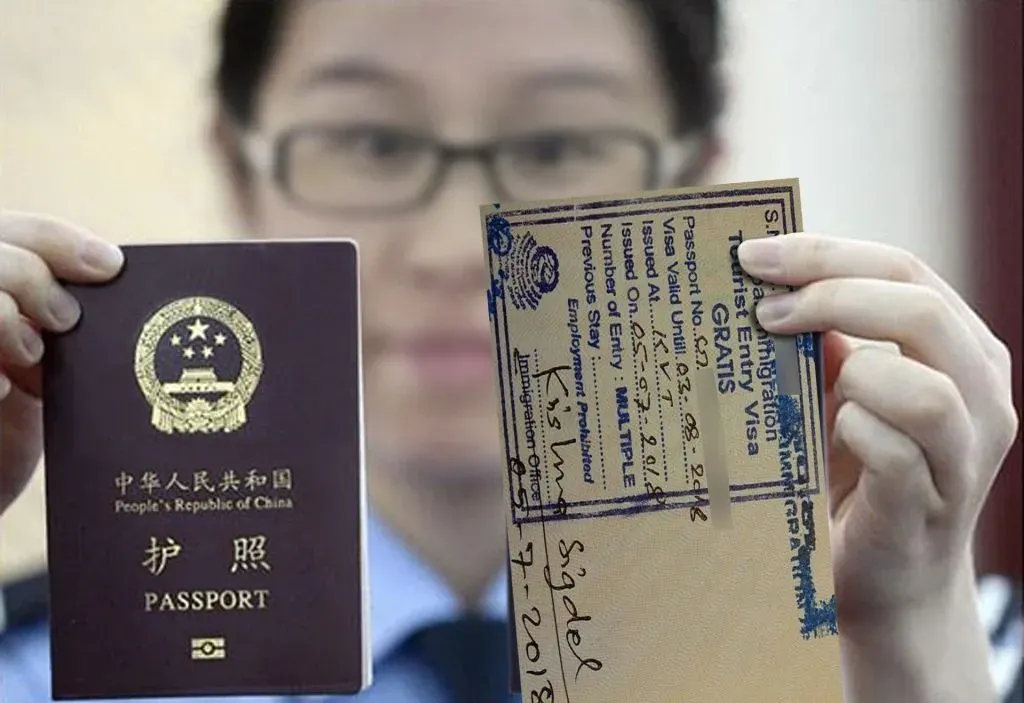
- China Group Visa: Your Nepal agency will submit your documents to the Chinese Embassy in Kathmandu to obtain the Chinese Group Visa, which is a single-entry visa that covers your stay in Tibet. Allow about three working days for it.
- Travel to Tibet: With your Chinese Group Visa and Tibet Travel Permit in hand, you can Start your journey to Tibet through the land border crossing at Rasuwagadhi on the Nepal side and Gyirong Port on the Tibet side.
- Onward Travel: Continue your journey into Tibet, where you can explore the wonders of this unique region.
One difference that matters when you come from Nepal. Travellers arriving from mainland China normally collect the Alien Travel Permit and any frontier pass in Lhasa. Coming in from Kathmandu you are already past Lhasa on day one if you are heading for Everest or Kailash, so those permits have to be issued before you leave Nepal. Your operator applies for the whole set together, which is the practical reason the Nepal route needs more lead time, not less.
How to Plan a Nepal to Tibet Tour
Kathmandu is the usual starting point for a trip to Tibet, because the Chinese Group Visa is issued there and the land border is a day’s drive away. Most people who travel to Tibet from Kathmandu do it on a fixed group departure, and planning your trip to Tibet from this side runs in four steps. Your operator will arrange the required Tibet travel permits as part of the booking, and your job is to give them enough time.
Step 1: Give yourself two or three days in Kathmandu. You need to be physically present for the group visa, and the embassy works on a fixed weekly cycle rather than on demand. Use the wait on the UNESCO sites of the Kathmandu valley, which is also useful acclimatisation practice before the plateau.
Step 2: Get the documents moving early. Send the scanned colour passport copy to your operator 20 to 30 days before departure. The Kathmandu to Tibet route needs more lead time than the mainland China route rather than less, because the extra travel permits have to be in hand before you leave Nepal. The Tibet Travel Permit is the long pole at 15 to 20 days, and the Military and Foreign Affairs permits for Kailash and eastern Tibet add another 10 to 15 business days on top, running in parallel.
Step 3: Choose flight or overland. Both are covered in the next section. The short version is that flying saves three days and overland acclimatises you properly.
Step 4: Fix the itinerary before you apply, not after. Because the permit names the places, adding Everest Base Camp or a Namtso Lake night after the file is submitted means a fresh application. Decide on the route first. Our three standard routes are the 8-day Tibet Overland Tour out of Kathmandu, the 8-day Lhasa to Everest Base Camp Tour, and the 7-day Lhasa to Kathmandu Overland Tour via EBC, which runs the plateau in the opposite direction and drops you back over the Gyirong border.
Flying to Lhasa or Driving Overland from Kathmandu
By air. Tribhuvan International Airport in Kathmandu has direct flights to Lhasa Gonggar, the quickest way into Tibet from Kathmandu, and the hop takes about 90 minutes with Himalayan views on a clear morning. The catch is altitude. Lhasa sits above 3,600M and you arrive there from Kathmandu at 1,400M in an hour and a half, so plan two easy days in the city before going higher, and skip alcohol, heavy exercise and long walks on the first afternoon.
By road. The overland route leaves Kathmandu on the road through Langtang National Park to Rasuwagadhi, crosses at Gyirong Port, and then joins the G318 Friendship Highway across the plateau. Most itineraries stop the first night in Gyirong Town precisely so the body has somewhere to sit between 1,400M and 4,000M. From there the highway runs past Everest north side, Tashilhunpo Monastery in Shigatse and the Kumbum stupa at Gyantse before reaching Lhasa.
| Fly Kathmandu to Lhasa | Drive via Gyirong Port | |
| Time to Lhasa | About 90 minutes | Several days, depending on stops |
| Acclimatisation | Abrupt, needs 2 rest days in Lhasa | Gradual, built into the drive |
| Scenery en route | Himalayan skyline from the air | Langtang, the border gorge, the plateau |
| Everest north side | Add a separate leg from Lhasa | On the way, via the Friendship Highway |
| Best for | Short trips and tight schedules | Anyone continuing to Everest or Kailash |
Both options need the same paperwork: the group visa, the entry permit and Tibet's route permits are identical either way. The choice does not change which travel permits you hold, only how quickly you arrive at altitude.
Best Time to Travel to Tibet from Nepal
The reliable window is April to June and September to October. Skies are clear, the passes are open and the Friendship Highway is in its best condition of the year. July and August are warm and the plateau itself stays fairly dry, but that is monsoon season on the Nepal side, and the road down to Rasuwagadhi is the part that suffers from landslides and delays, so overland groups plan slack into those months.
Winter is a different proposition. From December to February the plateau is cold and clear and Lhasa is quiet, but the high passes and the Kailash kora are effectively closed, and border formalities slow down. If Everest north side or Mount Kailash is the reason you are going, travel between April and October.
How long does it take to get a Tibet permit?
In general, the process typically takes around 15 to 20 days. The time it takes to obtain a Tibet Travel Permit can vary based on several factors, including the specific route you’re taking, the time of year, and the efficiency of the travel agency you’re working with.
Here’s a rough breakdown of the timeline:
- Application Preparation: This includes planning your itinerary and providing your passport and other personal information to your registered Tibet travel agency. This step can take a few days to a week, depending on your readiness.
- Permit Application: Once your travel agency submits your application to the Tibet Tourism Bureau in Lhasa, it usually takes around 10 to 15 days for them to process and approve your permit.
- Permit Delivery: After approval, the permit needs to be physically delivered to you, which might take a few additional days, depending on the delivery method and location.
Peak season is the variable most people underestimate. Between April and October the Bureau is working through a much larger volume of travel permits, so a file that clears in 10 days in March can take the full 15 in May. Start 30 days out if you can.
How Much Does a Tibet Permit Cost?
The Tibet Travel Permit itself is provided free of charge by the government. However, there are service fees associated with the permit application process. Travel agencies, like us, play a crucial role in securing the permit on behalf of tourists. This involves a significant investment of time and resources, including handling paperwork, liaising with government departments, and ensuring the permit reaches our clients. While our professional team in Lhasa expedites the Tourism Bureau stage, that stage alone typically takes 8 to 9 working days. Therefore, service fees are commonly applied, particularly for urgent applications. The exact cost may vary depending on the agency and your specific requirements.
Budget separately for the travel permits that are charged on the ground. The Alien Travel Permit is around 50 CNY per person and is paid there, and for the Military and Foreign Affairs permits if your route includes Kailash or eastern Tibet. Those are normally quoted inside a package price rather than charged at the counter.
is it possible to get a Tibet Travel Permit for free through Himalayan 360?
Absolutely Yes! When you choose us to travel to Tibet Lhasa and Kailash Mansarovar yatra, you have the opportunity to acquire the Tibet Travel Permit without any additional cost. This is made possible because we can submit group applications, which help save on human resource expenses.
Discover Our Recommended Tibet Group Tour Packages with Complimentary Tibet Permit.
- Kailash Mansarovar Yatra
- Tibet Overland Tour - 8 days from Kathmandu
- Lhasa to Kathmandu Overland Tour via EBC - 7 days
- Lhasa to Everest Base Camp Tour - 8 days
In addition to offering free Tibet Permit Application services, we go the extra mile by providing our clients with a 100% guaranteed Tibet Permit when they book their Tibet tours through us. This ensures a hassle-free and worry-free journey through this extraordinary region.
Book a Tibet tour with us and the paperwork stops being your problem. What is left is the travel experience itself, which is the reason to visit Tibet in the first place.
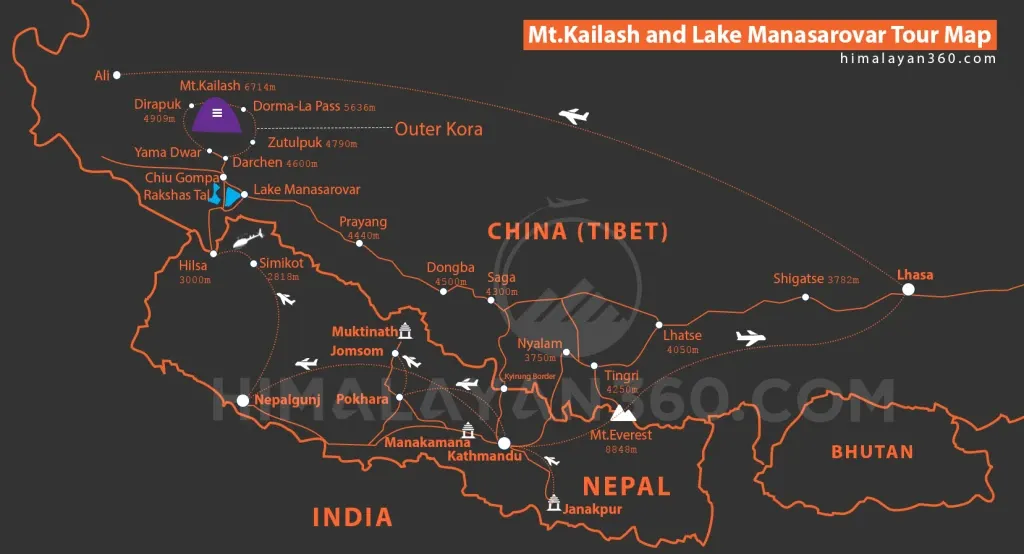
Kailash Mansarovar Yatra map
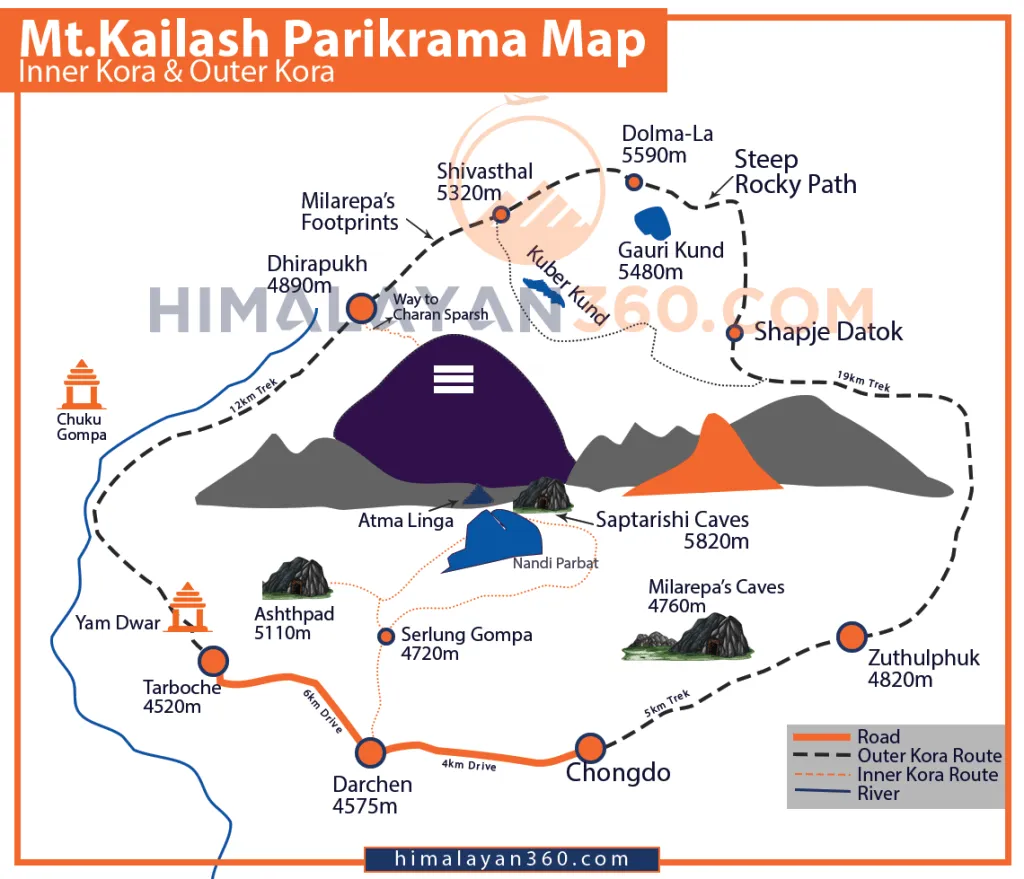
Kailash Mansarovar inner and outer kora Map
What Other Tibet Travel Permits Are Required for a Tibet Tour?
Traveling to Tibet is an adventure like no other, and it’s a land rich in diverse landscapes and spiritual experiences. However, when planning your Tibet tour, it’s important to be aware that in addition to the Tibet Travel Permit, you may need other travel permits to explore the more remote and sensitive areas. The permits beyond the basic Tibet Travel Permit are route-driven rather than nationality-driven, so the answer changes with your itinerary. If you plan to travel no further than Lhasa you will not meet any of them. Here are the Tibet permits you may need on top of it.
Alien’s Travel Permit:
If you intend to venture beyond Lhasa and explore uncharted territories like the Everest Base Camp in Shigatse or the Samye Monastery in Tsedang, you’ll need an Alien’s Travel Permit, also known as the PSB Permit. The Public Security Bureau (PSB) of Tibet issues this permit, and your Tibetan guide will assist you in obtaining it. Typically, the application involves submitting your passport, Chinese Visa/Chinese Group Visa, and Tibet Travel Permit. It’s a relatively quick process, taking a few hours, and costs around 50 CNY per participant.
Military Travel Permit:
The Military Office in Lhasa issues the Military Travel Permit, necessary for accessing some remote and military-sensitive regions like Mt. Kailash and eastern Tibet. This permit can take 10-15 business days to process, and it’s essential to apply through a travel agent. Make sure to have a copy of your passport and Chinese Group Visa/Chinese visa on hand. It’s advisable to apply for this permit well in advance, given the processing time. You’ll need it to explore the Ngari region, the Nyingchi region, and the Chamdo region.
Foreign Affairs Permit:
For certain highly sensitive and distant areas, such as Mt. Kailash and eastern Tibet, you’ll require a Foreign Affairs Permit in addition to the Military Travel Permit. The Foreign Affairs Office in Lhasa issues this permit, and the application process is similar, taking 10-15 business days. Like the Military Travel Permit, it’s recommended to apply through a travel agent, and you’ll need a copy of your passport and Chinese Group Visa/Chinese visa. If you plan to visit western Tibet, including Tholing and Tsaparang, the Cultural Antiquities Department will issue the Foreign Affairs Permit. Planning ahead is crucial, given the processing time.
 Trek
Trek By air
 Pilgrimage
 Festivals
 Wildlife
 Luxury
 Yoga
Yoga Food
Food Heritage