
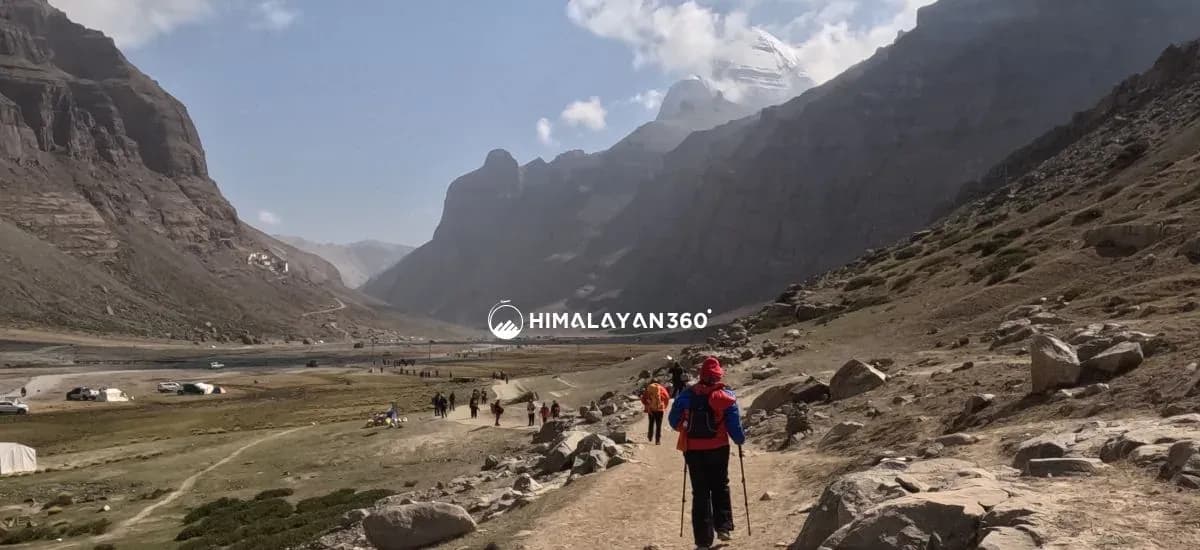
There are three types of Kailash Kora, the ritual kora around Mount Kailash that pilgrims walk rather than climb. The Outer Kora is a 52 to 56 km circuit walked over three days from Darchen, the Inner Kora is a roughly 32 km route behind Nandi Parvat that tradition reserves for pilgrims who have already completed twelve or thirteen Outer Koras, and the Spiral Kora is a four-stage expedition circuit that only specialised groups attempt.
Almost every commercial yatra sells the Outer Kora. The Inner and Spiral routes need special permits on top of the standard Tibet paperwork, so which one you can realistically walk is decided by permits, altitude tolerance and time rather than willingness. This guide covers all three, what each kora trek costs in days, what the accommodation is actually like, and what the walk means in Hinduism, Buddhism, Jainism and Bon. Whichever one you walk, it is the same Kailash pilgrimage underneath.
What is the Kailash Kora?
The Kailash Kora is the ritual kora circuit of Mount Kailash, walked rather than climbed, and it is the act the whole Mount Kailash pilgrimage is built around. To circumambulate Mount Kailash on foot is the point of the trip, and everything before it is transport. If someone tells you it is just a walk around a mountain, smile politely, because they have not walked past Day 1. Pilgrims believe that every time you complete the kora it washes away a lifetime of negativity, and the rhythm of it is something only this mountain creates.
The mountain in question is the 6,638 m peak in Ngari Prefecture, in the Tibet Autonomous Region of China. Indian pilgrims usually call it Kailash Parvat, Tibetans call it Kang Rinpoche, and English signage says Mt Kailash. It is not Adi Kailash, the Uttarakhand peak also called Chota Kailash, which has no comparable circuit. Reaching the kora start point at Darchen means crossing into Tibet, which is why the visa and permit rules further down this page apply.
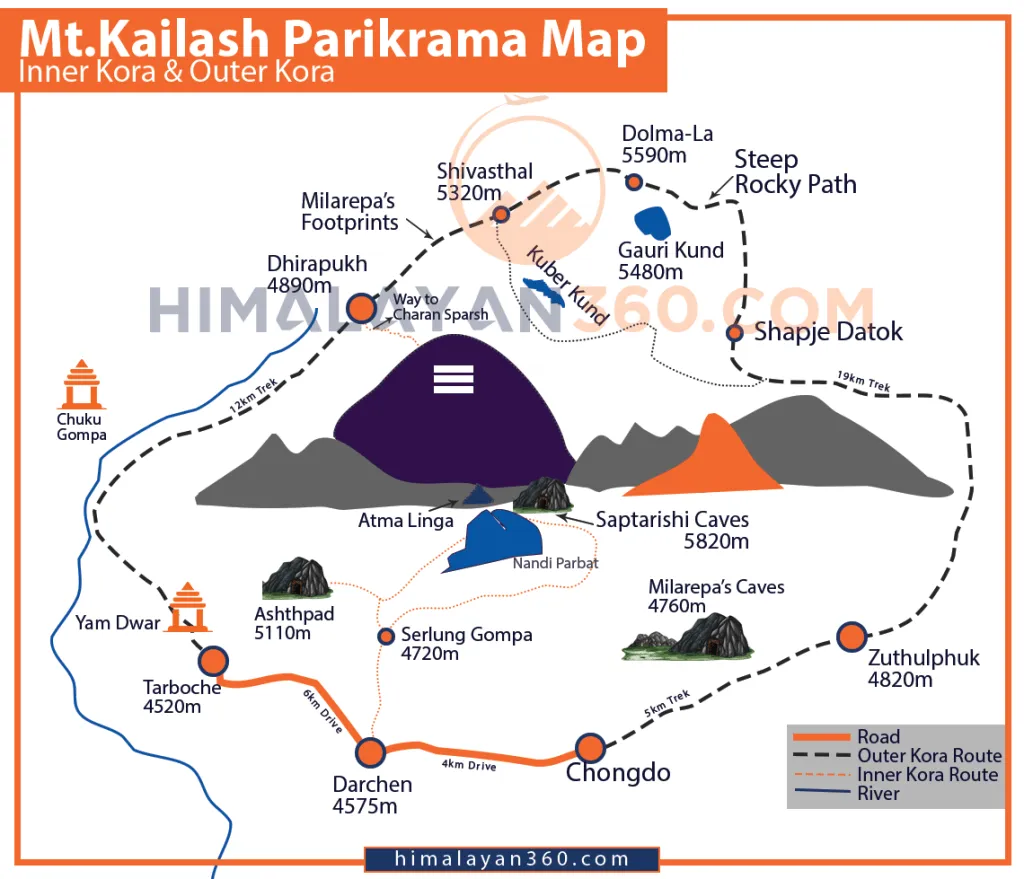
Kailash Kora Map for the Mount Kailash Parikrama
This Mount Kailash Parikrama map serves as a kora map for pilgrims navigating the Outer and Inner Kora routes. The legend at the bottom right explains the lines and symbols. For example, the orange line denotes the road segments, the dashed black line represents the Outer Kora route, and the dashed orange line denotes the Inner Kora route. Other symbols of temples, lakes, hills, and caves are used to indicate the landmarks. Further, the map also details numerous spiritual and geographical points with their altitudes, such as Milarepa’s Cave (4,760 m), Saptarishi Caves (5,820 m), Atma Linga, Gauri Kund (5,480 m), etc.
The Three Types of Kailash Kora
The three types of Kailash Kora: Outer, Inner, and the more In-Depth Spiral Kora offer you different ways to experience the sacred power of Mount Kailash. The Kailash Outer Kora and the Kailash Inner Kora account for almost every pilgrim who walks here, and the outer kora and inner kora differ in far more than length. Each path carries its own level of challenge and meaning. Let’s discuss them in brief:
The Beginner-Friendly Kailash Outer Kora Trek
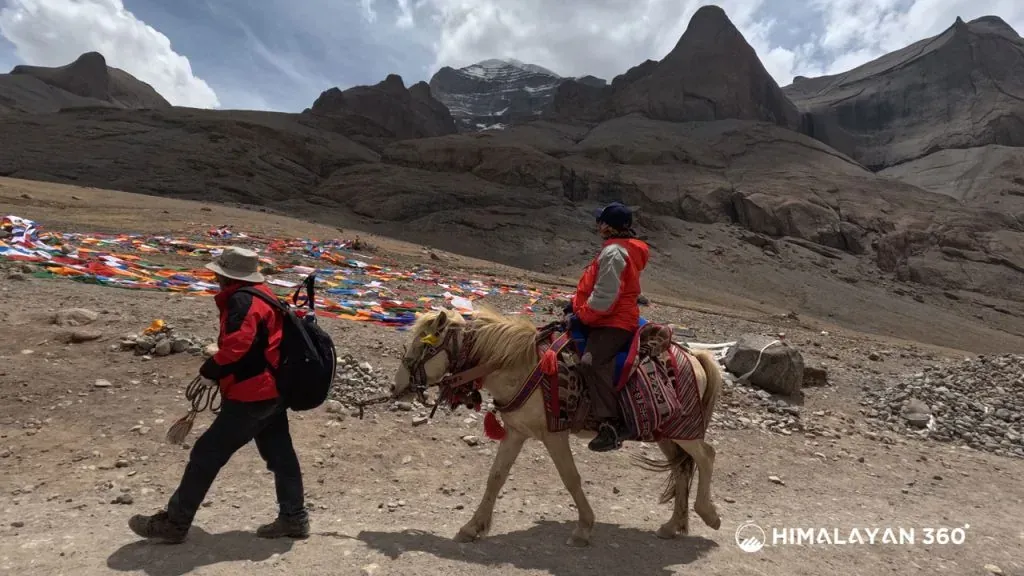
The Outer Kora is the most popular and beginner-friendly circuit around Mount Kailash, covering about 52-56 km. When somebody quotes a Kailash Kora distance without saying which route, this is the one they mean. It starts and ends in Darchen and is considered easier than the Inner Kora because of its better terrain and fewer acclimatization issues. The route includes the beautiful Lha Chu Valley, the Tarboche Flagpole, the climb to Dolma La Pass (5,630 m), a descent past Gauri Kund, and a final walk back from Zutulpuk Monastery. For most groups the Outer Kora trek is three walking days and two nights on the Kailash Kora route.
The Challenging Mount Kailash Inner Kora
The Mount Kailash Inner Kora is a far more difficult journey than the Outer Kora, and it begins near Dirapuk or with a short approach from Darchen. The route moves towards Asthapath, a highly respected place where Rishabhadeva is believed to have attained Nirvana. Pilgrims then circle Nandi Parvat, the buttress standing directly below the south face of Mount Kailash, so the inner kora trek spends most of its day in the gap between Kailash and Nandi. From there the route continues toward the Saptarishi Caves, where ancient sages are believed to have meditated. The inner kora of Mount Kailash is closed to anyone who does not hold the extra permit. The journey continues over high passes such as Khandosalgam La and Namdi La, both often above 5,700 m, keeping the route aligned with traditional practices.
In-Depth Spiral Kora: Choice of Advanced Practitioners
The In-Depth Spiral Kora is the most challenging type of Kora. Here, you have to complete the entire four levels of Kora: Sapphire Kora (the Outer Kora), Emerald Kora (parts of the Inner Kora, including Saptarishi Cave), Ruby Kora (higher passes and technical paths like the Secret Dakhini Path), and Golden Kora (the most difficult, crossing the pass which requires mountaineering skill). Completing this spiritual journey is believed to offer deep spiritual benefits like a closer connection to the sacred energy of the mountain.
Charan Sparsh Is Not a Type of Kora
Charan Sparsh gets listed alongside the Outer and Inner Kora, but it is a different thing. A kora is a full circuit of the mountain. Charan Sparsh is an out-and-back walk of about 7 km from Dirapuk Monastery to the north face of Mount Kailash, where pilgrims touch the base of the peak and return the same way. It circles nothing. Standing under the north face of Kailash is still the closest most pilgrims ever get to the mountain, and the view of Mount Kailash from that point is the one people photograph.
Most pilgrims add it to Day 1 of the Outer Kora, since the group already sleeps at Dirapuk, or take it as the centrepiece of a dedicated Kailash Charan Sparsh Tour. It suits people who want to stand at the mountain itself but are not confident about crossing Dolma La Pass at 5,630 m on Day 2.
Carbon Dating the Kailash “Kora”: History and Meaning
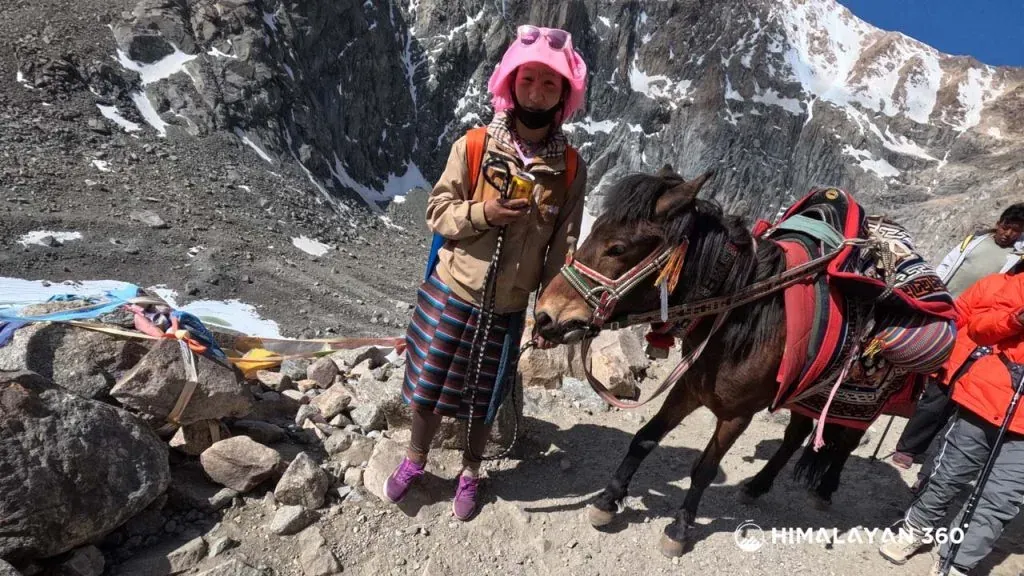
The history of Kailash Kora originated through ancient textbooks and historical accounts. The tradition of the kora pilgrimage around Mount Kailash, known as “Kora” in Tibetan Buddhism and Jainism, appears in sacred Hindu texts like the Vedas (second millennium BCE) and the Puranas (400-1500 CE). These scriptures identify the holy Kailash with Mount Meru, the cosmic center of the universe, and the permanent home of Lord Shiva.
The practice of the holy Kailash Kora symbolizes spiritual purification, with each circumambulation believed to cleanse sins and negative karma. Early pilgrims like the 13th-century monk Gyelwa Gotsangpa documented the journey, and later explorers such as Sven Hedin provided a detailed record of Kora in the 19th and early 20th century.
Best Time for Mount Kailash Kora in 2026
The season is short. The kora trail and the road in are open from May to September, and outside that window the passes hold snow, the guesthouses at Dirapuk and Zuthulpuk shut, and the region is closed to visitors. A Kailash Kora trek in December is not something any operator can legally run, and no Kailash trek in the region runs outside the open season.
Within the season, the Kailash Saga Dawa festival at Tarboche is the one date that changes the character of the walk. It falls on the full moon of the fourth Tibetan month, usually late May or June, and it draws Tibetan pilgrims in numbers to the flagpole raising at the start of the Outer Kora. If you want the ceremony and the crowd, aim for it. If you want an empty trail and a clear view of the sacred Mount Kailash, come after it. Anyone planning a Mount Kailash Kora in 2026 or later should start the permits months ahead either way, because the Chinese Group Visa is issued to the group and the group has to be closed before the paperwork begins. That is the honest answer on the best time for Mount Kailash Kora: inside the season, and booked early.
Tips for your Kailash Kora Itinerary
Fix these before you leave rather than on the trail, and build them into your Kailash Kora itinerary while it is still on paper.
- Begin 2-3 months in advance with jogging, cycling, swimming, or brisk walking to build stamina.
- Include rest days at Darchen and Lake Mansarovar to adjust to the high altitude.
- Get a medical check-up and discuss vaccinations and altitude sickness medication.
- Bring high-SPF sunscreen, sunglasses, a wide-brimmed hat, and SPF lip balm.
- ATMs are not available on the route, so carrying a small amount of local currency is best.
- Store copies of permits, passports, and insurance in waterproof bags.
- Focus on the spiritual journey, accept basic accommodation and simple food.
- Follow circumambulation rules and honour local traditions and fellow pilgrims.
Spiritual Significance of Kailash Kora in 4 Different Religions
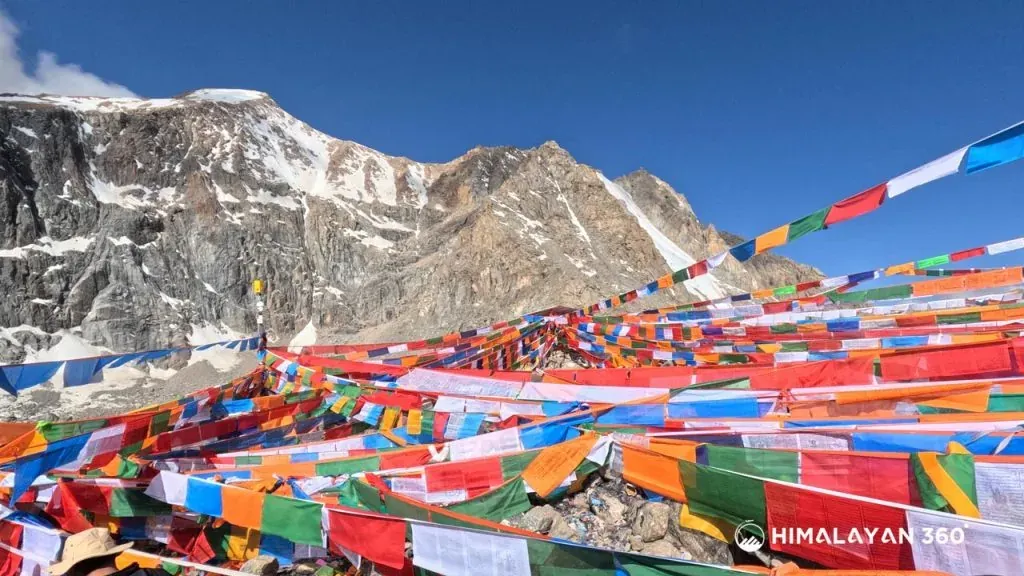
The Kailash Kora holds deep spiritual significance across four religions: Hinduism, Buddhism, Jainism, and Bon. Everyone who chooses to perform the Kailash Kora is doing the same walk for four different reasons, and the Kailash Kora pilgrimage gives each of them a path for purification and devotion. Each religion sees the mountain as a center of cosmic and spiritual power, and each expects the sacred Kailash Kora to send a pilgrim home with more inner peace than they arrived with. The spiritual Kailash Kora and the physical one are the same three days.
Abode of Lord Shiva in Hinduism
The Kailash Kora, or Parikrama, is very sacred in Hinduism because Mount Kailash is considered the home of Lord Shiva and Parvati. Completing the Kora is believed to cleanse sins, burn negative karma, and guide devotees toward moksha, or liberation from the cycle of rebirth. Key sacred sites along the route, like Lake Mansarovar, Yama Dwar, Dolma La Pass, and Gauri Kunda, offer pilgrims an opportunity for prayers and Hindu rituals.
Buddhism and Its Values of Purity
In Buddhism, the Kailash Kora is an act of devotion and purification to gain inner freedom and enlightenment. Mount Kailash, called Kang Rinpoche or “Precious Jewel Snows” in Buddhism, is considered the earthly home of Mount Meru, and the home of the deity Chakrasamvara and his consort Dorje Phagmo. Completing the Kora is believed to detoxify a lifetime of negative karma, with some devotees performing full-body prostrations for deeper purification.
Jain, A Counter-Clockwise Approach to the Circumambulation
In Jainism, Mount Kailash, known as Mount Asthapada or “Eight Steps“, is the most sacred pilgrimage site because it is where the first Tirthankara, Rishabhadeva, attained moksha from the cycle of birth and death. Jain pilgrims undertake the Kora mainly for meditation, reflection, and spiritual growth, following Rishabhadeva’s example. Traditionally, they walk counter-clockwise and have access to the Asthapada site, located near the North Face of Mount Kailash.
Bon and the Sky Goddess
In the Bon religion, Mount Kailash is also called Yungdrung Gutsek or the “nine-story swastika mountain“, and serves as the sacred home of Bon deities like the sky goddess Sipaimen. Completing the Kora is believed to cleanse past karmic actions and bring spiritual benefit, with pilgrims following the counter-clockwise path. The mountain is also linked to the founder of the Bon religion: Tonpa Shenrab Miwoche, who taught the Bon lessons around Mount Kailash many years ago.
Kailash Kora Requirements for Indian & Nepali Citizens
A note for Indian travellers: the kora described here circles Mount Kailash in Tibet, not Adi Kailash in Uttarakhand. To reach Mount Kailash you have to enter the Tibet Autonomous Region, so the Chinese visa and Tibet permits below apply to every route, including the ones that start in India.
Hence, the Kailash Kora is open again for Indian citizens from 2025 after the border issue was resolved. Indian and Nepali travellers must follow updated rules, including getting Tibetan travel permits and a Chinese visa, to join the pilgrimage through a Kailash Mansarovar Yatra Tour Package 2026.
For Indian Citizens
- Indian Citizens must join an organised Kailash tour, as independent travel to Kailash is not allowed.
- All paperwork is processed only through MEA (Govt. of India) or an authorized travel operator.
- Valid Indian Passport with at least 6 months validity beyond the return date and two blank pages.
- Tibet Travel Permit (TTP) issued by the Tibet Tourism Bureau, arranged by your agency.
- Aliens Travel Permit (ATP) required for restricted regions like Mount Kailash; issued through your operator
- Adhaar Card or Voter ID copy as proof of Indian nationality for the Nepal route, if you’re going through us.
- Medical Fitness Certificate from a certified MBBS doctor stating you are fit, along with travel insurance.
For Nepali Citizens
- Nepali Citizens must join a licensed group tour like our Kailash Mansarovar Yatra from Kathmandu, as independent travel to Kailash is not allowed.
- All permits and visas should be processed only through an authorized tour operator in Nepal.
- A copy of the Nepali Citizenship Certificate is required alongside a Valid Nepali Passport.
- Chinese Group Visa is required, which is issued by the Chinese Embassy in Kathmandu; provided as a separate paper visa, not a passport stamp.
- Tibet Travel Permit (TTP) and Alien’s Travel Permit (ATP)
- All logistics, like transportation, permits, accommodations, and the Kora route, must be arranged through a registered tour operator.
Accommodation Status for Each Kora Category
Accommodation in the Mount Kailash region is simple and basic, and it varies depending on which Kora category you choose. Nothing in the Kailash area is built for comfort. Facilities across the region around Mount Kailash range from guesthouses to shared lodges, and the comfort level decreases as you move towards higher and more remote sections.
Within Outer Kora
Accommodation on the Outer Kora is open from May to October, but facilities remain basic throughout the route. Most pilgrims stay in simple guesthouses at Dirapuk and Zuthulpuk, where rooms are cold, shared, and without showers, and toilets are usually outdoor huts. Electricity is limited, and most trekkers rely on their own sleeping bags for warmth. The only place in the Mount Kailash area with better options is Darchen, where 3-4 star hotels are available before and after the Kora. During the trek, comfort is minimal, so carrying essentials like snacks, hygiene items, and medications is important.
Within Inner Kora
Accommodation on the Inner Kora is far more challenging than the Outer Kora, as the route has almost no permanent shelters. Most pilgrims stay in tented camps arranged by their tour operator, including sleeping tents, dining tents, and simple toilet tents. A few mud houses near monasteries like Sherlung Gompa or Gyandrak Monastery may exist, but availability is rare. There are no tea shops or supply points on this route, so groups must be fully self-sufficient with food, water, and camping gear.
Within Spiral Kora
Accommodation for the Spiral Kora is extremely basic, as these deeper routes have no guesthouses or tenthouses at all. Pilgrims rely entirely on the expedition-style tented camps, with crews carrying all camping and kitchen equipment through remote, high-altitude terrain. Access to the inner “Ruby” and “Golden” routes is tightly restricted and allowed only with special permits, so only specialized groups can attempt them. The only comfortable stay available is in Darchen, before and after the Kora.
Choose Better: Tabular Summary for Inner and Outer Kailash Kora
| Feature | Outer Kora (Sapphire Kora) | Inner Kora (Emerald Kora / Nandi Kora) |
| Primary Purpose | Standard pilgrimage, cleansing general karma, accessible to a wider audience. | Deeper spiritual journey, greater karmic benefit, closer proximity to sacred sites. |
| Distance | Approx. 52 km (32 miles) | Approx. 32 km (20 miles) |
| Duration | 3 days (typically) | 1 long, intense day or 2 days with camping |
| Difficulty | Moderate/Challenging | Extremely Difficult |
| Max Altitude | Dolma La Pass (5,630 m) | Sanglam La Pass (approx. 5,680 m) |
| Traditional Rule | Can be done by any pilgrim. | Traditionally requires 12 (or 13) Outer Koras first. |
| Accommodation | Basic monastery guesthouses/mud houses. | Tented camps (primary), minimal basic huts. |
| Key Sites | Yama Dwar, Dirapuk Monastery, Dolma La Pass, Gauri Kund. | Asthapada (South Face views), Saptarishi Caves, Atmalingam, Nandi Parvat. |
| Accessibility | Open during peak season, many organized tours are available. | Requires special permits and specialized, professional guides; restricted access. |
Difficulties Faced during any of the Kailash Koras
Altitude sickness during Kailash Kora walks is the single most common reason people turn back, and our guide to altitude sickness on the Kailash Mansarovar Yatra covers the symptoms and the treatment in full.
- High Altitude & Oxygen Shortage: Trek elevation reduces oxygen levels up to 50%, causing headaches, nausea, dizziness, and fatigue.
- Rapid Elevation Gain: Quick ascent increases the body’s stress and adaptation challenges.
- Harsh & Unpredictable Weather: Nights can drop below -10°C; sudden snowstorms, rain, and high UV exposure are common.
- Long Trekking Hours: Daily walks can last 6-11 hours on demanding trails.
- Basic Accommodation: Outer Kora has shared dorms with outer toilets, Inner and Spiral Koras require self-sufficient tents.
- Limited Medical Facilities: Emergency healthcare is scarce, evacuation is difficult and expensive.
- Mental & Emotional Strain: Isolation, fatigue, language barriers, and spiritual pressure test mental strength.
Choosing Your Kailash Kora Tour
The Kailash kora offers different levels of spiritual and physical challenge, from the accessible Outer Kora to the challenging Inner Kora and the extreme In-Depth Spiral Kora. Each route provides a different experience, views, and spiritual benefits. Whichever you choose, you perform the kora on foot, so pilgrims must be well-prepared, physically fit, and aware of the harsh high-altitude conditions. If this journey feels strenuous with changing flights and all, then the Kailash Mansarovar Yatra by Helicopter can be a convenient option for you. Try it out with our team and fulfill your spiritual dream of circumambulating Mount Kailash. Whichever Kailash yatra or Kailash Mansarovar tour you book, the trek around Mount Kailash is the part you will remember, and the journey around Mount Kailash is what the rest of the itinerary exists to deliver.


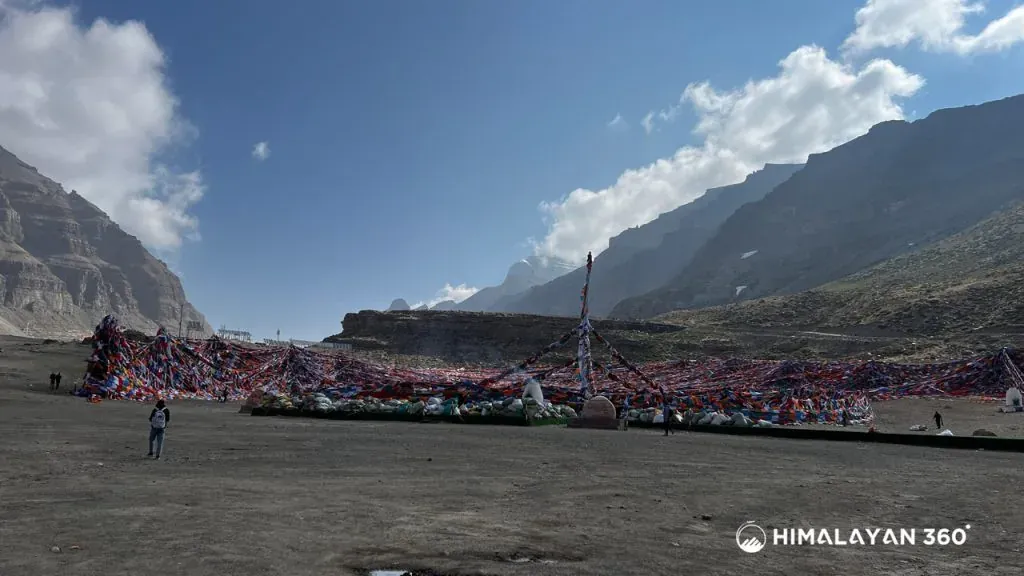
14 Days
Kailash Mansarovar Yatra
$2,770
5.0(6 reviews)
The Kailash Mansarovar Yatra from Nepal is one of the world’s most demanding and most revered pilgrimages — a journey to Mount Kailash (6,638 m) and the sacred Lake Mansarovar on the high plateau of western Tibet. This is our 14-day overland yatra, departing from Kathmandu and crossing into Tibet at the Rasuwagadhi–Gyirong border. It is the route most pilgrims choose: slower than the helicopter, which means your body acclimatises properly instead of being dropped at altitude, and far less expensive. You travel through the Himalayan foothills, over the Tibetan plateau, past Lake Mansarovar, and finally around Mount Kailash itself on the three-day Kora. Mount Kailash is held sacred by four faiths. Hindus know it as the abode of Lord Shiva. Buddhists know it as the seat of Demchog (Chakrasamvara). Jains revere it as the place where their first Tirthankara attained liberation. For Bon followers it is the axis of the world. Lake Mansarovar, at its foot, is believed in Hindu tradition to have been created by Lord Brahma. We have operated this pilgrimage since 2014. We arrange the Chinese Group Visa, all four Tibet-side permits, accommodation, transport, meals, oxygen and a medical kit, and Nepali- and Hindi-speaking support throughout. Groups run 5–20 pilgrims. 2027 departures are open now. Bookings for the May–September 2027 season are being taken from August 2026, and the earlier you book, the better your choice of date.
 Trek
Trek By air
 Pilgrimage
 Festivals
 Wildlife
 Luxury
 Yoga
Yoga Food
Food Heritage